

GREEN COLLAR ENVIRONMENTAL EMPLOYMENT VACANCIES
The Rise of the Green Collar Economy: Your Guide to a Sustainable Career
The global job market is undergoing a massive shift. As industries worldwide race to meet climate targets and adopt sustainable practices, a new class of workforce has emerged: the Green Collar professional.
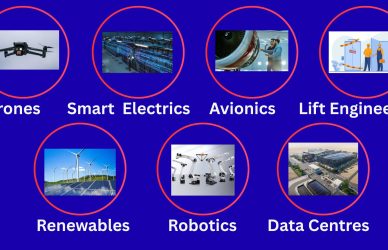
No longer a niche sector, sustainability is now a core business driver. Whether you are entering the workforce for the first time or looking to pivot your career,green industries offer some of the most resilient, high paying, and purposeful opportunities of our generation.In my opinion this is a very good sector along with my other topical subjects like Automation & Robotics, Data Centres, Logistics and fulfillment centres, Airport Baggage Handling Systems (BHS) that really needs top class skilled Blue Collar labour. It is a sector that if we believe the talk that AI is going to make a lot of jobs redundant then it is a sector ripe for Upskilling from white collar to blue and green collar workers. Even Meta has just announced big plans to pour $115m into an America’s Workforce Academy (AWA) program and is a nationwide, unprecedented fast-track to a long-term career in a skilled trade. It’s a program that supports all participants while they learn and then guarantees a job for all graduates.
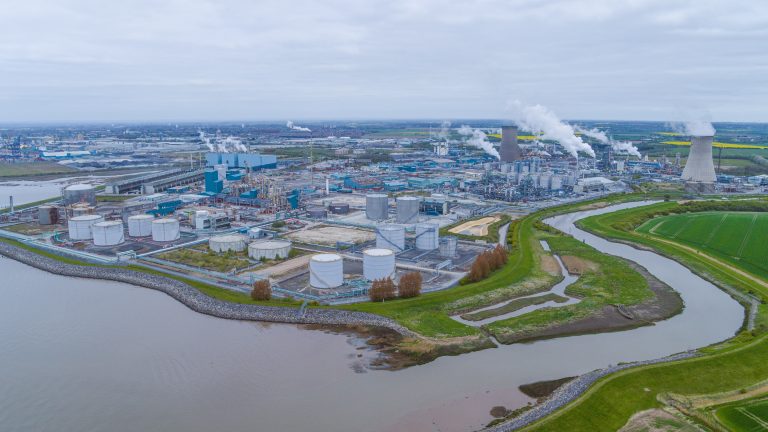
My passion for supporting “green-collar” workers stems from a firm belief that the transition to a sustainable economy must be driven by practical, well-supported human labour rather than just policy ideals. It is easy to discuss sweeping climate goals, but the actual transformation of our infrastructure happens through the skilled hands of technicians, engineers, and retrofitters who are building our low-carbon future. A stark reminder of this reality surfaced in recent local news out of the Humber region, where the Humber Energy Board, alongside over thirty regional organizations and local authorities, sent an urgent appeal to the Energy Secretary to secure funding for the UK’s first regional hydrogen transport and storage network. This major industrial push highlights that achieving ambitious net-zero milestones relies entirely on future-proofing our industrial clusters and rapidly training a specialized workforce to manage complex carbon-capture and hydrogen technologies. I am deeply interested in this space because apart from originally been brought up in this area, I am glad to see that these green-collar workers are championed, properly upskilled, and given stable career paths is the single most critical factor in turning regional climate targets into tangible, lived reality.
What exactly are ” Green Collar ” Jobs ?
While traditional blue-collar jobs involve manual labour-collar jobs and white- collar jobs focus on clerical or professional office settings,green-collar jobs cross both spectrums. Simply put, a green-collar job is any position design- engineered to preserve, restore or improve the environmental quality. This spans multiple booming sectors, including:
- Renewable Energy (Solar, Wind, Hydro )
- Sustainable Agriculture, Agri-Tech, Hydroponics
- Clean Transportation & Electric Vehicles (EV)
- Green Building & Eco-Friendly Architecture
- Circular Economy & Waste Management
TOP HIGH GROWTH SECTORS TO WATCH
- Renewable Energy Technicians: Solar photovoltaic installers and wind turbine technicians remain among the fastest growing occupations globally. These technical roles offer excellent upward mobility and geographic flexibility.
- Sustainability Consultants & Managers: Corporate boardrooms are actively hiring specialists to audit their carbon footprints, oversee ESG (Environmental, Social and Governance ) reporting , and re-design supply chains.
- Urban Agriculturalists & Ecologists: as cities aim to reduce food miles, urban farming and smart water management systems are creating localized micro-economies.
One of the many UK Government initiatives driving the the quest for green-collar workers is the long-awaited Warm Homes Plan and promises to provide £15bn to households across the UK over the next five years, as well as introducing new rights for renters.The government has said it wants to create a “rooftop revolution”, tripling the number of homes with solar, and lifting one million people out of fuel poverty.
Measures in the plan include:
- Extending the Boiler Upgrade Scheme by a further year to 2029/30, offering £7,500 grants for air source heat pumps
- Additional £600m for low-income households to receive funding for the full cost of solar panels and batteries taking the total available to £5bn
- Low and zero-interest loans for households irrespective of income
The plan has been strongly welcomed by the energy industry, workers’ unions, and the finance sector, who see the long-term financial commitment by the government as crucial for driving private investment into green technologies. The government has said the scheme would contribute to 180,000 new jobs in the clean heating sector – although some of these are likely to be from retraining existing engineers.
THE GREEN SKILLS GAP: What Employers are looking for
- A major challenge facing the Green transition is the “skills gap, ” industries are growing faster than talent pools can adapt. To stand out to modern recruiters, you need a blend of Technical expertise and soft, system-level thinking.
- Carbon Accounting & ESGR Reporting: Understanding how to measure and report environmental impact using international frameworks.
- Circular Design Thinking: Designing products and life- cycles that eliminate waste and keeps materials in continuous use.
- Environmental Law & Compliance: Navigating the increasingly complex web of local and international environmental regulations.
- Renewable Technology Maintenance: Practical certifications in electrical engineering , solar grid integration, or automated building systems.
Now at this moment in time it is not only the “Green-Collar ” industries that are suffering a lack of skills, many other sectors with “Blue-Collar “skills which are directly comparable are also suffering. In their latest article Forbes the Global Media brand reported that ” The demand for Skilled Trades is growing, they state one of the reasons as the Silver Tsunami which translates as the people that once had these chosen professions are retiring and nobody has appreciated the need to train future generations up, starting with Trade Apprenticeships. The UK are making this a big priority for the country, a number of initiatives have opened up to offer openings to get in to the green economy, for example:
- The UK is currently in the middle of an unprecedented green energy boom. The government’s Clean Power 2030 (CP30) Action Plan has legally locked in targets to triple solar capacity and quadruple offshore wind capacity by 2030, transforming the UK into what the Department for Energy Security and Net Zero calls a “clean energy superpower.”
- The UK is already a global leader in offshore wind, but the scale of what is being built right now is staggering. In a massive funding round, the UK government awarded Contracts for Difference (CfD) support to a massive 8.4GW of new offshore wind capacity.
- The National Energy System Operator (NESO) cleared 132GW of new renewable projects for “Phase 1” delivery. While Scotland’s onshore wind pipeline is already heavily subscribed, England and Wales are the new gold rushes for land-based turbine installations
- The UK passed the milestone of 20GW of installed solar capacity, with a target to reach 45–47GW by 2030. The government allocated up to £295 million in funding specifically for solar PV projects, unlocking massive utility-scale developments.
- The Grid and Battery Storage: You can build all the wind and solar farms you want, but they are useless if the power grid can’t handle them. The “Gate 2” Connection Reform: The UK radically overhauled how it handles grid connection requests. In a massive clean-up, Ofgem and NESO gave the green light to 283GW of generation and storage projects that proved they were ready to build, while kicking out speculative projects.
What This Means for Your Career Transition
This scale of investment has created a severe supply-chain bottleneck, not of money, but of human beings. The UK is facing a massive shortage of high-voltage electricians, mechanical technicians, turbine blades specialists, and PLC automation programmers to hook these systems up. Because the government is legally committed to these 2030 and 2035 targets, these projects have ironclad financial backing, making green-collar infrastructure jobs among the safest, most AI-proof careers in Britain today.
The good news for anyone who has experience of office work, IT or project work is that you do not need to go back to school for 4 years to go Green. Many of the skills that you already possess are highly transferable. But lets start with people who are just leaving school and embarking on their new career, obviously they will have the best chance of getting an apprenticeship and hopefully if that’s what they intend to do they will have got good advice off their school Careers Teacher. Do not be on the mis-understanding that apprenticeships are for the young.
How to Apply for Adult Apprenticeships
It is a common misconception that apprenticeships are only for 16-to-19-year-olds. In the UK, there is no upper age limit for an apprenticeship. Because the government covers training costs for high-demand green roles, employers actively look for mature adults who bring life experience, reliability, and transferable skills.
The Two Fast-Track Funding Routes
Before looking for traditional multi-year apprenticeships, look into the government’s Skills Bootcamps. These are free, flexible courses lasting up to 16 weeks designed for adults (19+) to quickly upskill into green trades. The Big Benefit: They are fully funded by the government, often lead directly to an NVQ or GWO accreditation, and guarantee you a job interview with a local employer upon completion. You can find them via the National Careers Service portal.
The Step-by-Step Application Process
If you want to go the full “earn-while-you-learn” apprenticeship route (which blends full-time paid work with day-release college training):
1.Search the National Portals: 10 mins. Use the official Find an Apprenticeship service on GOV.UK (if you are in England) or Apprenticeships.scot (if in Scotland). Filter specifically by keywords like Renewable, Electrical, Mechatronics, or Wind Turbine.
2.Target the Energy Giants Directly: 2-3 hours. The largest green-collar employers bypass the general government boards and recruit through their own corporate portals. Set up job alerts directly on the careers pages for SSE, ScottishPower, EDF Energy, Octopus Energy, and Ørsted.
3.Reformat Your CV for Transferable Skills: 1 hour. Employers hiring adult apprentices care about reliability. Rewrite your CV to highlight physical stamina, problem-solving, teamwork, safety awareness, and a clean driving license (which is mandatory for almost all field-based green jobs).
4.Apply During the Peak Windows: Ongoing. Large energy infrastructure companies open their massive apprentice intake windows between January and May for cohorts starting in September. Local solar and electrical contractors hire year-round based on project demand.
NOTE: A Reality Check on Wages: As an adult apprentice, companies are required to pay you at least the National Minimum Wage for your age bracket after your first year, though major green energy employers (like SSE or Ørsted) typically start their adult apprentice salaries significantly higher (often between £19,000 to £24,000 per year) because they know adults have bills to pay.
MY TRANSFERABLE SKILLS, ARE THEY RELEVANT ?
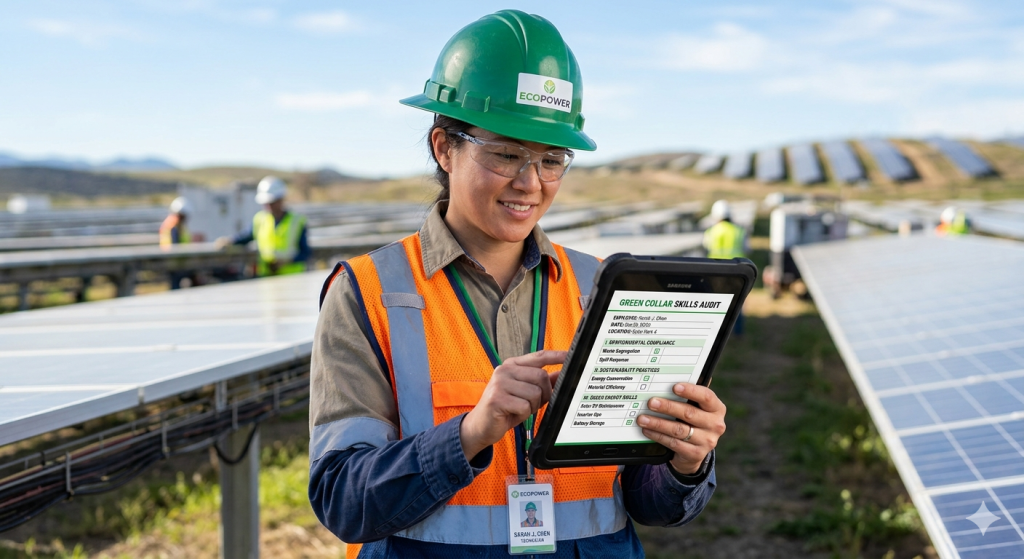
The “Green Collar” sector isn’t just for environmental scientists; it desperately needs project managers, tradespeople, tech specialists, and administrators. Use this step-by-step audit to map your existing skills to the green economy.
Step 1: Deconstruct Your Current Role
Before looking at green jobs, break down what you actually do every day into core functions.
[ ] List your daily responsibilities: Strip away your specific industry jargon. Instead of “Managed software implementation for a bank,” write “Led cross-functional tech implementation and timeline management.”
[ ] Identify your core data/analytical skills: Do you budget, forecast, manage supply chains, or analyze compliance data? (Green jobs heavily rely on sustainability compliance and resource tracking).
[ ] Identify your hands-on/technical skills: If you are in the trades, manufacturing, or engineering, list your exact technical competencies (e.g., electrical wiring, HVAC, blueprint reading, precision machining).
Step 2: Categorize Your Soft & Universal Skills
Green industries are scaling incredibly fast, meaning “power skills” are highly sought after to manage the transition. Check off the ones you excel at:
[ ] Project Management & Delivery: Agile methodologies, logistics, budgeting, or vendor management.
[ ] Problem Solving & Innovation: Experience in optimizing inefficient processes, lean manufacturing, or waste reduction.
[ ] Communication & Stakeholder Management: Experience dealing with government regulations, community relations, or cross-departmental training.
[ ] Adaptability & Continuous Learning: Proof that you can learn new systems, technologies, or regulations quickly.
Step 3: Map to Green Collar Equivalents
Now, match your existing expertise to where the green economy needs it most.
If your background is in… Construction / Traditional Trades
[ ] Map to: Energy-efficiency retrofitting, heat pump installation, EV charging infrastructure, solar array installation, or smart-grid maintenance.
If your background is in… Logistics / Supply Chain / Manufacturing
[ ] Map to: Circular economy logistics, sustainable material sourcing, waste stream management, or clean energy manufacturing.
If your background is in… Tech / Data / Engineering
[ ] Map to: Climate tech development, carbon accounting software, grid optimization data analytics, or environmental engineering.
- If your background is in… Operations / Admin / Management
[ ] Map to: ESG (Environmental, Social, and Governance) reporting, green project management, or sustainability compliance.
Step 4: Identify the “Green Knowledge Gap”
Most of your skills will transfer, but you may need a layer of “green context.”
[ ] Identify regulatory gaps: Do you need to learn local environmental laws, carbon reporting standards, or specific green building codes (like LEED or BREEAM)?
[ ] Identify technical gaps: Do you need a short-course certification to pivot your existing knowledge? (e.g., an electrician taking a course on EV charging points, or a project manager getting an ESG certification).
Step 5: Translate Your Resume for Green Recruiters
[ ] Rewrite your bio/summary: Frame yourself as a “[Your Profession] specializing in efficiency, optimization, and driving the transition to [Target Green Sector].”
[ ] Quantify your “green-adjacent” achievements: Update your bullet points to highlight efficiency. Example: “Reduced material waste by 15%” or “Optimized route logistics to cut fuel consumption.”
[ ] Align your vocabulary: Swap out old industry terms for green economy terms (e.g., change “resource management” to “sustainability asset management” where applicable).

CONCLUSION: THE FUTURE IS GREEN-COLLAR

The Green economy isn’t just a passing trend, it is a definitive future of work. By positioning yourself today within sustainable fields and building an eco-conscious skill set, you aren’t just future-proofing your career;you are actively contributing to a liveable planet.