SAFETY SPOTLIGHT -SAFETY LIGHT CURTAIN
Safety Light Curtains. In the world of high-speed automation, they are essentially the “invisible shields” that keep the factory floor running without, well, accidental dismemberment. It’s a perfect bridge between high-tech sensing and industrial ethics.
Imagine a robotic arm moving at six meters per second—a blur of steel and precision. Now imagine a human operator needing to step into that workspace to clear a jammed part. In the old days, you’d pull a physical lever, wait for a full stop, and lose precious minutes of uptime. Today, the machine “feels” your presence before you even touch it.
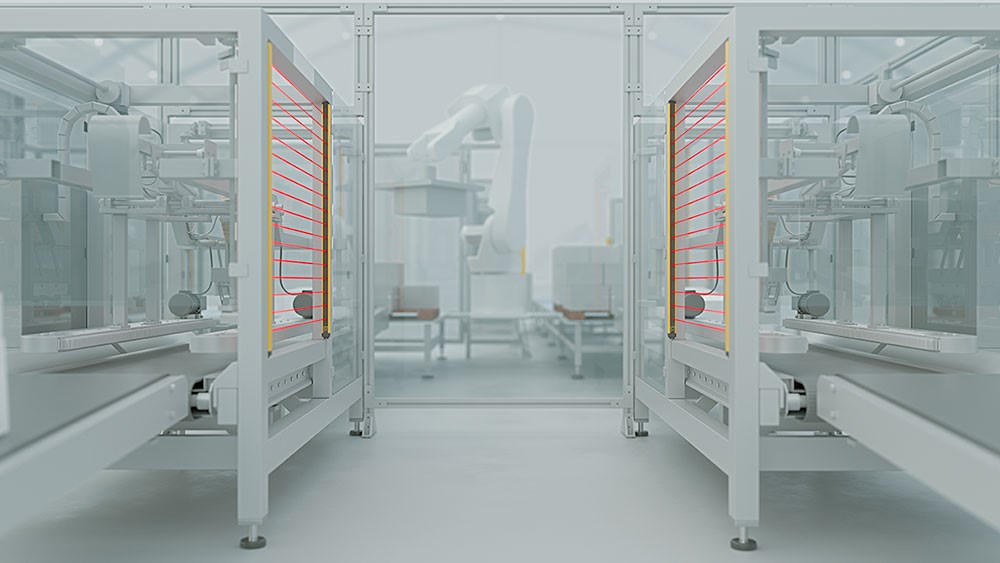
There are no gates to swing, no buttons to mash. There is only a thin, shimmering plane of infrared light. Cross it, and the machine freezes in milliseconds. This is the silent choreography of the Safety Light Curtain, the technology that turned the “danger zone” into a collaborative workspace.
Defining the Light Curtain
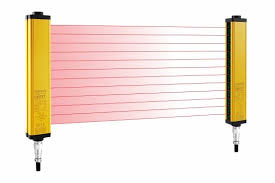
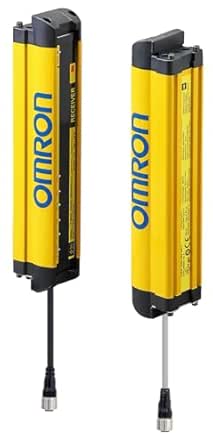
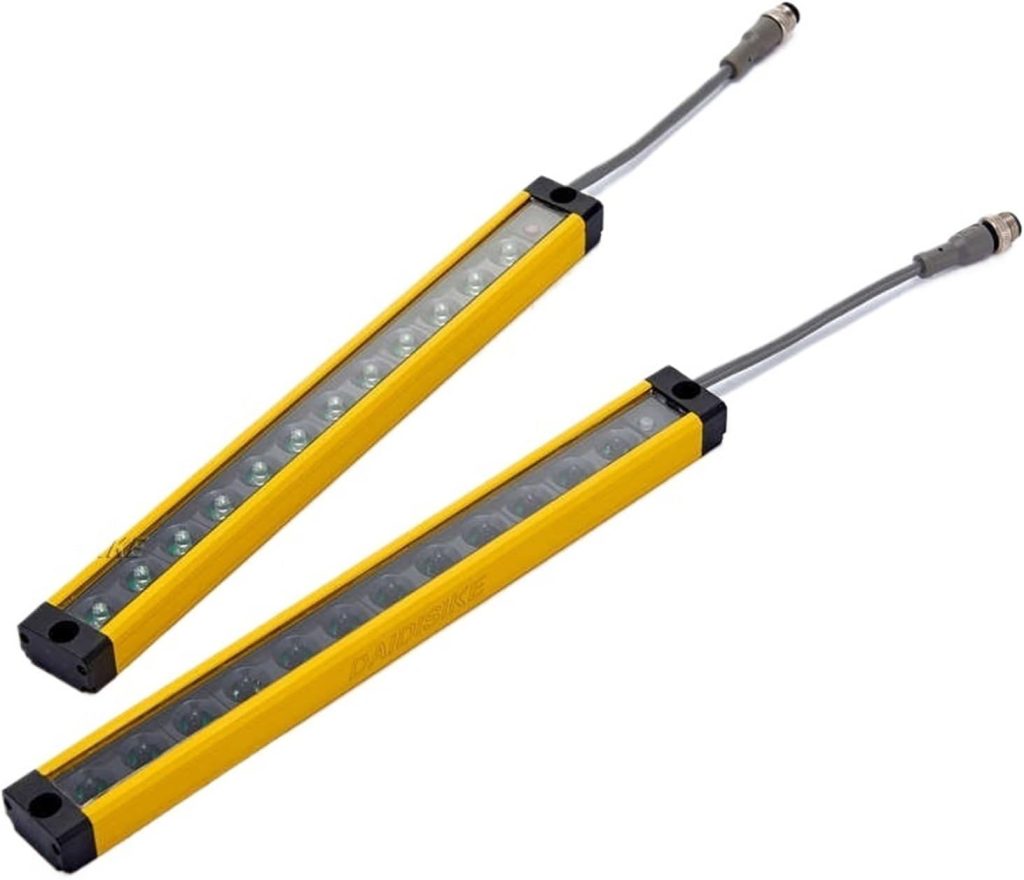
A Safety Light Curtain (technically an Active Opto-electronic Protective Device or AOPD) is a presence-sensing safeguarding device used to protect personnel from injury related to hazardous machine motion. By emitting a dense grid of infrared beams between a transmitter and receiver, these devices create a virtual perimeter.
Unlike mechanical guards or fences, light curtains allow for:
Frequent Access: Operators can enter and exit the zone without manual gate cycles.
Space Efficiency: They reduce the physical footprint of a safety cell.
Enhanced Visibility: Keeping the “line of sight” open for supervisors and maintenance.
The Major Players: Industry Leaders
If you are looking for the “Gold Standard” in the safety world, these are the companies that dominate the market share and set the technical standards:
| Company | Key Strength | Known For |
| Keyence | Ease of Use | Extremely compact sensors and built-in alignment indicators that simplify setup. |
| SICK AG | Innovation | Often credited with inventing the first light curtain; they offer the widest range of specialized “Muting” and “Blanking” features. |
| Banner Engineering | Durability | Known for ruggedized hardware (like the EZ-SCREEN) designed for harsh, dirty industrial environments. |
| OMRON | Integration | Excellent at “total automation,” where the light curtain communicates seamlessly with their Sysmac safety controllers. |
| Rockwell Automation (Allen-Bradley) | North American Standard | The go-to for many US-based automotive and heavy manufacturing plants due to deep integration with Logix systems. |
| Schmersal | Specialized Safety | A heavy hitter in European markets with a massive focus on functional safety compliance and machinery directives |
Its important at this stage that we define the difference between how Point of Operation Control (POC) and Perimeter Access Control (PAC) differ in application and hardware. Distinguishing between these two types of guarding is essential because the physics of the hazard—and the speed at which a person can reach it—change drastically between a finger and a whole body, for both types, you must follow standards like ISO 13855. It is very important that the Safety requirements are calculated during the Pre-Installation procedures and a budget agreed.
1. Point of Operation Control (POC)
This is “close-in” guarding designed to stop a machine before a body part reaches the pinch point or hazard zone. Because the person is usually standing right at the machine the response must be nearly instantaneous. A Point of Operation Control (POC) safety light curtain is a photoelectric device used to protect personnel from hazards like cutting, pressing, or shearing by creating a vertical light curtain. Examples include Type 4, 14mm-30mm resolution curtains (like the Allen Bradley Guardmaster GuardShield) placed closely in front of mechanical presses, robotic cells, or hydraulic equipment to instantly halt movement if a finger or hand breaks the beam
Resolution (Detection Capability): Usually 14mm (for fingers) or 30mm (for hands). The beams are packed tightly together so a small digit cannot pass through undetected.
Mounting Distance: Generally mounted very close to the hazard. The distance is calculated based on the machine’s “stop time.”
- Primary Goal: To prevent injury during the actual production cycle while allowing the operator to load/unload parts frequently.

- Press Brakes/Stamping Presses: High-resolution light curtains (e.g., 14mm-30mm) are positioned directly at the dangerous, pinch-point area to ensure that if an operator’s hand breaks the field, the press stops instantly.
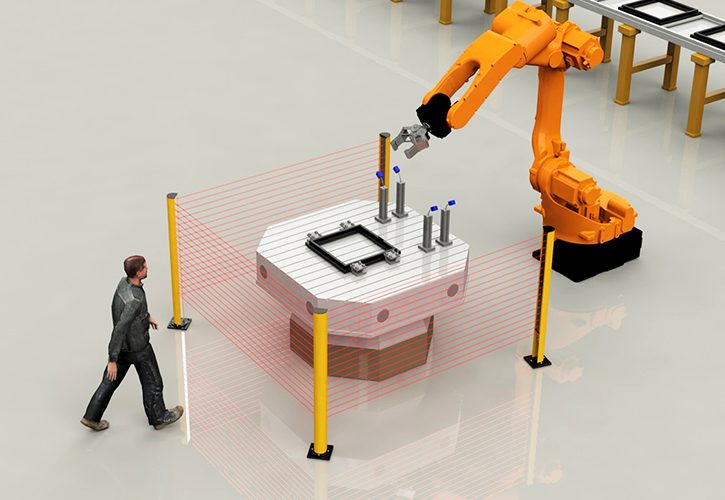
- Pick-and-Place Robots: A compact light curtain installed at the robot cell entrance acts as a vertical barrier that halts movement if a person enters.
- Automated Assembly Machines: They protect workers from hazardous motion, such as during automated tool changes in a CNC machine.
2. Perimeter Access Control (PAC)
This is “boundary” guarding. It isn’t meant to catch a hand reaching for a gear; it’s meant to detect a full human torso or body walking into a restricted area, such as a robotic welding cell.
Resolution: Much coarser, typically multi-beam (2, 3, or 4 beams) spaced several hundred millimeters apart.
Mounting Distance: Mounted further away from the hazard. Since the “object” (a person) is walking, you need enough distance between the light curtain and the robot to ensure the robot stops completely before the person can reach it.
Latching/Reset: Crucially, PAC systems usually require a manual reset button located outside the cell. This ensures a robot doesn’t restart while someone is still standing inside the perimeter out of view.
Key Differences at a Glance
| Feature | Point of Operation (POC) | Perimeter Access (PAC) |
| Object Detected | Finger or Hand | Full Body / Torso |
| Beam Spacing | Very tight ($<$ 30mm) | Wide (300mm – 500mm) |
| Typical Hazard | Presses, shears, assembly | Robots, conveyors, palletizers |
| Operator Intent | Frequent reaching in/out | Entering a restricted zone |
| Safety Distance | Short (calculated by $S = K \times T + C$) | Long (to account for walking speed) |
When opaque objects (such as human body parts) enter the protected area of the light curtain, they will block part or all of the light beam, causing the receiver to be unable to receive the complete signal. At this time, the safety light curtain will immediately send out a shutdown signal to prevent the mechanical equipment from continuing to operate, thereby avoiding the occurrence of injury accidents.
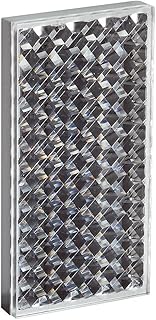
In order to expand the scope of the protected area, safety light curtains can use reflectors to change the transmission direction of light. By properly arranging the reflectors, the light curtain that can originally only form a single-sided protection can be expanded into a protection area of 2, 3 or even 4 sides. In this way, dangerous areas can be covered more effectively and the reliability and comprehensiveness of safety protection can be improved.
The Concept of ” Muting “
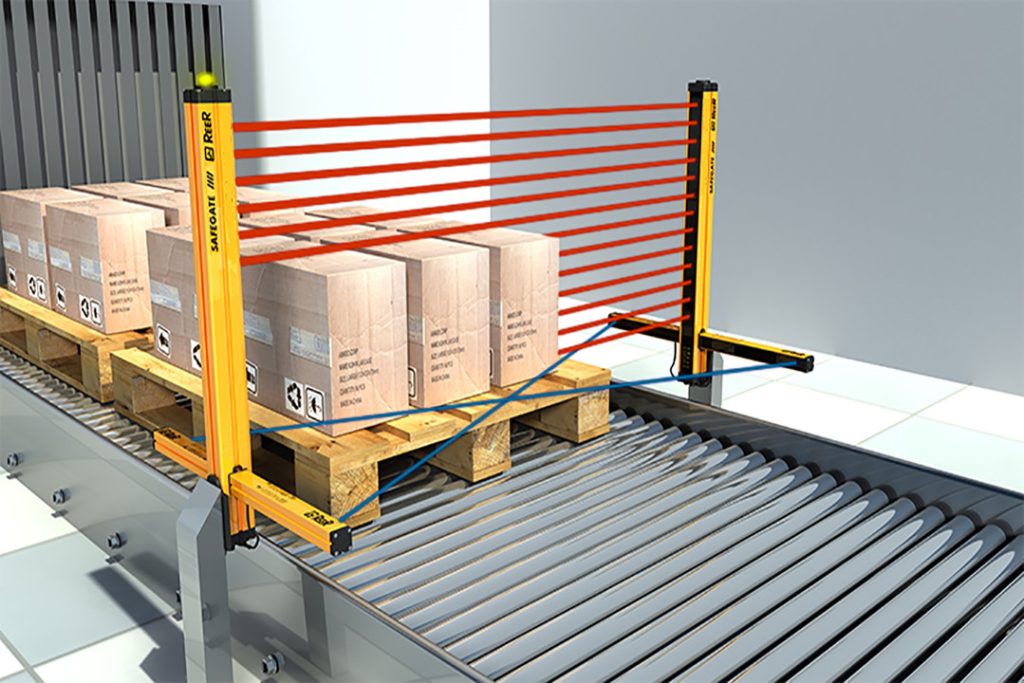
The concept of “Muting” is a cornerstone of modern industrial automation, allowing for the seamless flow of goods without compromising human safety. In the UK and Europe, SICK AG is widely regarded as the primary architect of this technology .While a standard light curtain will stop a machine the moment any beam is broken, a muting system uses additional sensors to distinguish between personnel (who must be protected) and material (which must pass through).
How it Works:
To initiate a “mute,” a specific sequence or pattern of triggers must be met. If the sequence is incorrect (e.g., a human walking through instead of a pallet), the light curtain remains active and triggers an emergency stop.
Common Muting Configurations:
Cross-Muting (X-Type): Two sensors cross paths in front of the light curtain. When both are triggered simultaneously by a wide object (like a pallet), the curtain mutes. This is ideal for space-saving at entry/exit points.
- Sequential Muting (T-Type): Uses four sensors (two before and two after the curtain). This allows for bidirectional travel and is highly reliable against “manipulation” (someone trying to trick the sensors).
- Exit-Only Muting (L-Type): Uses two sensors placed only on the “hazardous” side. It allows material to exit the machine but will trip if someone tries to enter from the outside.
Spotlight on SICK AG: The Pioneers of Optical Safety
Based in Waldkirch, Germany, SICK AG is not just a manufacturer; they are the historical “inventors” of the safety light curtain. Their influence in the UK and European markets is foundational.
Historical Context
The 1951 Breakthrough: Dr. Erwin Sick presented the first wooden model of a “light curtain” at the Munich Inventors’ Fair. By 1952, he had patented the autocollimation principle, which allowed for a single-ended light curtain using a mirror—the birth of modern optical machine guarding.
- Setting the Standards: SICK has been a lead contributor to the development of European safety standards, such as EN ISO 13849 (Functional Safety) and IEC 61496 (Electro-sensitive protective equipment)
Importance in Europe and the UK
Compliance Leadership: In the UK, SICK is a primary resource for companies navigating PUWER (Provision and Use of Work Equipment Regulations). They provide the “Gold Standard” for stop-time testing and risk assessment.
Innovation vs. Commodity: While many companies now make light curtains, SICK moved the industry forward by integrating muting logic directly into the hardware (e.g., the deTec4 series), removing the need for complex external PLC programming.
The “Green Light” Symbol: SICK’s distinctive design and reliability have made them a “safe bet” for European Tier-1 automotive and logistics hubs, where downtime is measured in thousands of pounds per minute.
Summary of Importance
| Feature | Importance |
| Productivity | Muting prevents “nuisance trips,” keeping the production line moving. |
| Legal Certainty | Using SICK technology ensures compliance with rigorous EU/UK safety directives. |
| Smart Diagnostics | Modern SICK systems use IO-Link and NFC (Smartphone apps) for instant troubleshooting of muting errors. |
BLANKING Blanking: The “Space-Based” Bypass
Blanking disables a specific portion (certain beams) of the light curtain while the rest of the curtain remains active and protective. This is used when a machine part or a conveyor rail must permanently or semi-permanently obstruct the sensing field.
There are two primary types of Blanking:
A. Fixed Blanking
A specific set of beams is permanently “turned off” because a fixed object (like a mounting bracket or a stationary conveyor) is in the way.
Behaviour: If that object is moved, the curtain will trip (as it expects the object to be there).
Risk: If the blanked area is large, a person could potentially crawl through the “hole” in the safety field.
B. Floating Blanking
Allows an object to move up and down within the sensing field without tripping the alarm, provided it only blocks a specific number of beams (e.g., 1 or 2 beams).
Use Case: A cable carrier or a moving workpiece that shifts slightly during operation.
Constraint: If more beams are broken than the “floating” limit allows, or if a second object enters the field, the machine stops.
Comparison at a Glance
| Feature | Muting | Blanking |
| Area Affected | The entire sensing field. | Only specific beams/zones. |
| Duration | Temporary (during a cycle). | Permanent or continuous. |
| Control | External sensors (triggers). | Internal configuration/programming. |
| Typical Object | Pallets, vehicles, finished goods. | Conveyor rails, tool supports, cables. |
| Human Safety | Safe because it’s “timed” to material. | Requires careful calculation of “hole” size. |
Critical Safety Note: The “Gap” Factor
When using Blanking, you are effectively creating a hole in your safety fence. Safety standards (like ISO 13855) require that the resolution of the light curtain be recalculated. If the blanked area is large enough for a hand or arm to pass through without being detected, additional physical guarding or “tunnelling” must be installed to prevent access.
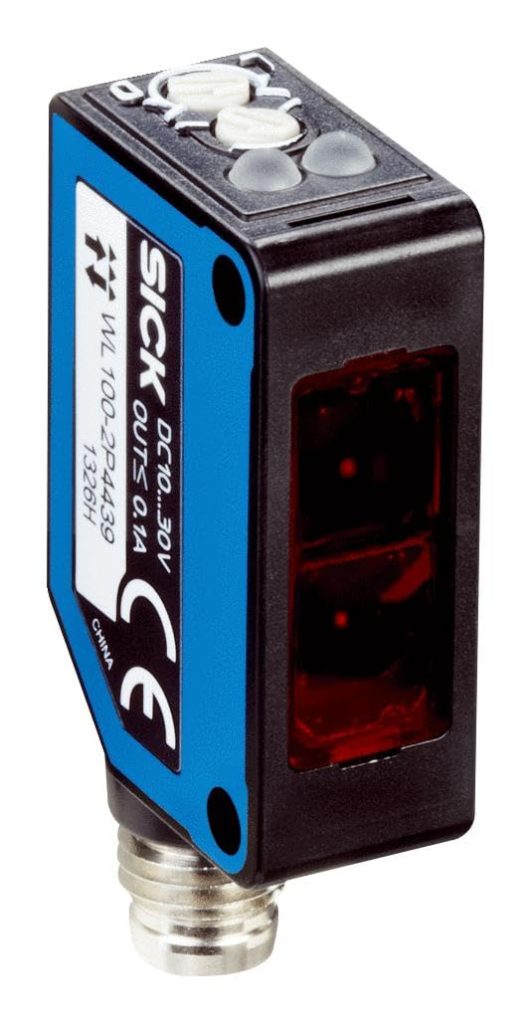
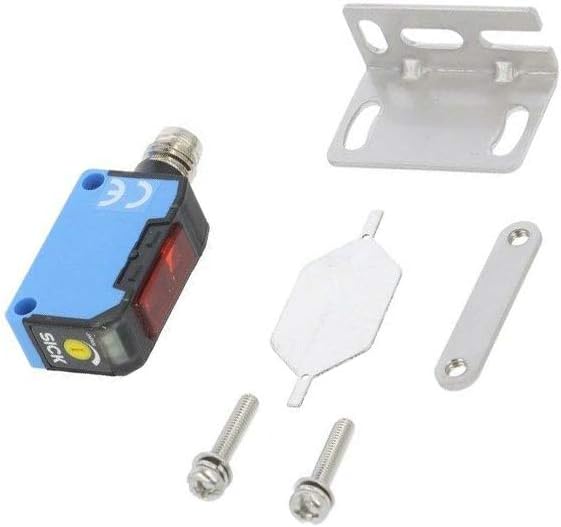
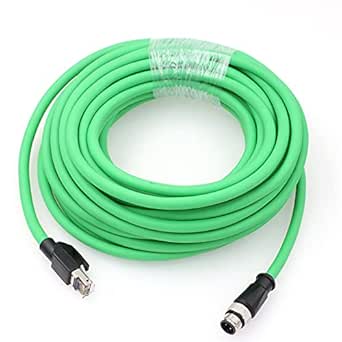
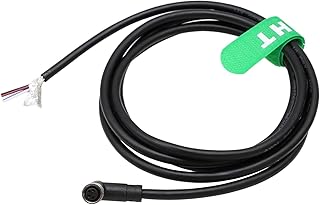
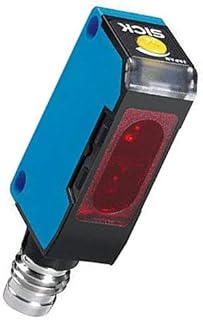
SICK – RANGE OF SAFETY LIGHT CURTAINS & SENSORS.
As An AMAZON Associate I may earn from Qualifying Purchases at no Extra Cost to Yourselves.