




In April 6th 2000 the UK Government brought in a new Tax legislation called IR35 (also known as the Off-Payroll Working rules) with the aim of identifying and sifting out those Contractors and Freelancers that were seen as “employees in disguise” rather than a genuine business in a deliberate effort to pay less tax.
INSIDE IR35 v OUTSIDE IR35
| Status | Inside IR35 (Deemed Employee) | Outside IR35 (Genuine Business) |
| Tax Treatment | PAYE (Pay As You Earn): You are treated as an employee for tax purposes. Income Tax and National Insurance Contributions (NICs) are deducted at source (like a standard employee). | Tax-Efficient: You operate through your Limited Company (PSC), pay Corporation Tax on profits, and take income as a combination of a small salary and tax-efficient Dividends. |
| Take-Home Pay | Lower | Higher (due to the tax efficiency of dividends and ability to claim expenses). |
| Who Pays the Tax? | The Fee-Payer (usually the recruitment agency or client) is responsible for deducting the tax and NICs. | The Contractor’s Limited Company (PSC) is responsible for paying all taxes (Corporation Tax, PAYE/NICs on salary, and Dividend Tax). |
| Work Relationship | Resembles employment. The client often controls how, when, and where you work, and you are expected to perform the services personally (no right to substitute). | Resembles a business-to-business (B2B) service. You have control over how the services are delivered and may have the right to send a substitute. |
| Recommended Payment Method | Umbrella Company (to handle PAYE payroll) or having the Fee-Payer deduct tax directly. | Limited Company (to benefit from the tax structure). |
Key Determining Factors
HMRC looks at the overall working arrangement, focusing on three main tests to determine status.
- Control: Who decides how the work is done? (Client = Inside; Contractor = Outside).
Substitution: Do you have a genuine right to send a qualified substitute to do the work in your place? (No = Inside; Yes = Outside)
Location of Employment: Obviously if you are working periodically overseas you will nedd to seek Professional advice on how your tax affairs will be regarded by the country that you are performing your work in and your Residence status.
.Mutuality of Obligation (MOO): Is the client obliged to offer you continuous work, and are you obliged to accept it? (Yes = Inside; No = Outside).
In short, Inside IR35 means you pay tax like an employee, and Outside IR35 means you pay tax like a true business.
Many skilled professionals and skilled blue-collar workers in the robotics field work on a contract basis, making this information highly relevant so looking a bit deeper -An Umbrella Company in the UK acts as an intermediary, effectively employing a contractor who works on temporary assignments for various clients (usually via a recruitment agency). The umbrella company handles all the payroll, tax, and National Insurance (NICs) deductions via the Pay As You Earn (PAYE) system, just like a traditional employer.
Pros of Using an Umbrella Company
The main appeal of an umbrella company is simplicity and compliance, making it a great option for those new to contracting or on short-term/Inside IR35 roles.
Minimal Administration & Paperwork: The umbrella company handles all your invoicing, tax, and NICs calculations. All you typically have to do is submit your timesheets and any valid expenses. This means:
No need to set up or run your own Limited Company.
No need to hire an accountant for company accounts or annual tax returns (unless you have other income sources).
Compliance with UK Tax Law: Since you are paid via PAYE, the umbrella company ensures that all your Income Tax and NICs are correctly deducted before you receive your salary. This provides peace of mind and reduces the risk of future investigations from HMRC (Her Majesty’s Revenue and Customs), especially regarding the complex IR35 regulations.
Employee Rights and Benefits: As an employee of the umbrella company, you gain access to statutory employment rights, including:
Statutory Sick Pay (SSP).
Statutory Holiday Pay (usually paid as ‘rolled-up’ pay or accrued).
Statutory Maternity/Paternity Pay.
Auto-enrolment into a workplace pension scheme.
Continuity of Employment: If you stay with the same umbrella company, you maintain a single, continuous employment record across multiple contracts. This can be beneficial for applications like mortgages or loans.
Easy to Start and Stop: Registering with an umbrella is fast and straightforward, with no lock-in periods or joining/leaving fees from compliant providers. It’s an easy, low-risk way to start contracting.
Cons of Using an Umbrella Company
The primary drawback is reduced take-home pay and less control over your financial affairs compared to a Limited Company.
Reduced Tax Efficiency: All your income is paid as a salary under PAYE. This is less tax-efficient than operating a Limited Company (outside IR35), where directors can typically take a combination of a small salary and dividends, which are not subject to NICs.
The Assignment Rate Trap: The gross rate the umbrella company receives from the agency often includes Employer’s National Insurance Contributions and the Apprenticeship Levy, which are then deducted before your salary is calculated. This means the advertised “assignment rate” is not your effective gross salary.
Umbrella Company Fees (Margin): The umbrella company charges a weekly or monthly fee (their “margin”) for their service, which is deducted from your earnings. While typically small (e.g., £20-£30 per week), this is an extra cost you wouldn’t have with your own Limited Company.
Limited Expense Claims: Since 2016, a contractor working through an umbrella is generally not able to claim tax relief on travel and subsistence expenses if they are subject to Supervision, Direction, or Control (SDC) by the client. In practice, this applies to the majority of umbrella workers, limiting the expenses you can claim compared to a Limited Company.
Less Financial Control: You relinquish control over your financial planning and tax affairs. You cannot decide when to draw down funds, which limits opportunities for tax planning.
Unregulated Market Risks: The umbrella market is currently not formally regulated by a government body, meaning there is a risk of non-compliant providers. You must be vigilant to avoid tax avoidance schemes (often disguised as loan or offshore schemes) that promise unrealistically high take-home pay, as getting involved can lead to large tax bills and penalties from HMRC. Always use an umbrella accredited by a recognised body like the FCSA (Freelancer & Contractor Services Association).
The Verdict for Robotics Professionals & Skilled Workers
Scenario Recommendation Why? Short-term contracts (e.g., < 6 months) Umbrella Company Quick to set up, minimal admin, and you avoid the costs/complexity of forming and dissolving a company. Inside IR35 contracts Umbrella Company As a PAYE employee, the IR35 rules are automatically satisfied, making it the most straightforward and compliant option. New to Contracting Umbrella Company Provides a risk-free, simple way to ease into contracting without the administrative burden. Long-term, high-rate contracts (Outside IR35) Limited Company More tax-efficient, offering a greater net income and more control over business expenses and financial strategy. A bit deeper dive below with some price and salary retention expectations
UK Contractor Structure Comparison
Feature Umbrella Company (Employee of Umbrella) Limited Company (Director/Shareholder) Tax Status & Efficiency Least Efficient. All income is taxed via PAYE (Pay As You Earn) at standard Income Tax and Employee National Insurance (NICs) rates. Most Efficient (Outside IR35). Income is split into a low salary (for State Pension credit) and Dividends, which are taxed at a lower rate than salary and are not subject to NICs. Estimated Take-Home Pay 60% – 70% of the gross contract rate (after all taxes, NICs, and employer costs are deducted). 75% – 80% of the gross contract rate (after Corporation Tax, salary deductions, and dividend tax). Administrative Burden Very Low. You simply submit a timesheet. The umbrella handles all invoicing, payroll, tax deductions, and HMRC compliance. High. You are responsible for all bookkeeping, VAT returns, payroll (running the low salary), annual financial accounts, and Corporation Tax submissions. Startup / Ongoing Costs Low. Weekly/monthly margin (typically £20 – £30) paid to the umbrella company. High. Annual accountant fees (typically £1,000 – £2,000+), software subscriptions, and registration fees. Expense Claims Very Limited. Generally, only non-travel expenses (like professional subscriptions) are claimable due to Supervision, Direction, or Control (SDC) rules. High Flexibility. You can claim a wide range of legitimate business expenses (e.g., accountancy fees, training, equipment, home office costs) to reduce your company’s Corporation Tax liability. IR35 Impact Irrelevant. Since you are already paid via PAYE, you are always compliant. This is the default choice for “Inside IR35” contracts. Critical. Only viable for “Outside IR35” contracts. Being “Inside IR35” negates the tax benefits and complicates compliance. Liability None. The umbrella company is your employer, protecting you from personal liability. Limited Liability. Your personal assets are protected from business debts (a major legal advantage). Benefits Statutory Employee Rights: Holiday Pay, Sick Pay, Pension Auto-Enrolment. None directly. You must provide your own insurance, sick cover, and pension contributions (though company contributions are tax-efficient). There are hundreds of potential Umbrella Companies out there, all competing for your hard earned salary to make them some money also, so how do we weed out the unreliable ones ?
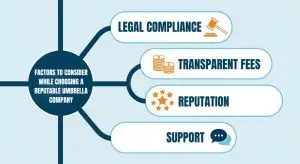 Selecting the right umbrella provider is crucial. Here are the factors you should consider:
- Legal Compliance: The company should be fully compliant with HMRC (His Majesty’s Revenue and Customs) & IR35 (Inland Revenue 35) regulations, which are necessary for anyone using umbrella payroll services.
- HMRC: Ensures that all income tax and national insurance deductions are correctly processed.
- IR35 Legislation: Applies to contractors who would otherwise be considered employees for tax purposes, affecting how tax is calculated and paid.
- Contractor Obligations:
- You’ll need to check your employment status and understand your tax position.
- Report any suspicious or non-compliant practices to HMRC.
- Keep all payslips and reconciliation statements for your records.
- Transparent Fees: Look for clear, upfront pricing and detailed payslips.
- Reputation: Choose a provider with strong client reviews and industry standing.
- Support: Good umbrella companies offer responsive support and legal advice when needed.
Please ask about additional benefits, check for hidden fees, and make sure the company has a local branch or UK presence if you need that support.
IF YOU ARE THINKING OF WORKING ABROAD
If you are seeking employment abroad and you can fulfil the quite rigid criteria that Brexit has imposed on British Skilled Workers and Freelancers then its best to plan in advance so that you can survive your first days and maybe weeks at work, different rules apply in individual European countries and I know from personal experience how hard contracting in Sweden can be, not the work but the regulation.Even Ireland that was a no-problem to work there destination has Red Tape in place that has to be overcome.
- Legal Compliance: The company should be fully compliant with HMRC (His Majesty’s Revenue and Customs) & IR35 (Inland Revenue 35) regulations, which are necessary for anyone using umbrella payroll services.
“Most Umbrella companies pay out in the local currency. If you’re a cross-border contractor, use Wise to receive your salary. You get a dedicated IBAN and avoid the ‘hidden’ exchange rate fees that high-street banks charge.” Don’t let bank fees eat your pay check. If you’re being paid in EUR but live elsewhere (or vice-versa), use Wise to receive funds with local IBAN details and convert them at the mid-market rate, as a contractor myself, I use Wise to manage my European invoices when I have been working in Europe. It is easy to set up and you get a Debit card sent out very quickly. With lots of employment taking off in Ireland at the moment, especially in the Pharmaceutical ad Food Industries the WISE account could be a good addition..
WISE is a Global Technology Company that’s building the Best way to move money around the World.