
The Warehouse Renaissance: How Robotics is Rewriting the Blue-Collar Career Path
For decades, the engine of the logistics warehouse was human endurance—thousands of miles walked annually, back-breaking shifts, and constant, repetitive manual labour. But as we move deeper into 2026, the silence of a modern fulfillment centre speaks volumes about a shifting reality. From the vast, sprawling hubs of Amazon to the strategic distribution networks of DHL across Europe, the warehouse floor is undergoing a seismic reconfiguration. This isn’t merely the story of robots replacing workers; it is a complex tale of how automation is bridging the gap left by a shrinking labour pool, turning traditional blue-collar roles into high-tech, skilled trade positions that are safer, smarter, and more essential than ever before.
1. Introduction: From Muscle to Mechatronics
The Era of Muscle (Pre-1950s to 1980s)
In this stage, warehouses were essentially static storage boxes. Success depended on the physical stamina of the workforce.
Technology: Manual pallet jacks, basic forklifts, and paper-based clipboards.
Workflow: Workers physically walked miles of aisles to find items (a process called “person-to-goods”).
The Constraint: Throughput was limited by human fatigue and the error rates inherent in manual data entry.
The Rise of Mechanisation (1990s to early 2000s)
This phase introduced “dumb” machines to help humans move faster. We saw the introduction of basic conveyor belts and Warehouse Management Systems (WMS).
Technology: Basic sensors, barcode scanners, and fixed-path conveyors.
Workflow: The focus shifted to reducing travel time, but the machines were rigid—if one belt broke, the whole line stopped.
The Mechatronics Revolution (Present Day)
We are now in the age of intelligent movement. Mechatronics—the synergy of mechanical engineering, electronics, and smart software—allows the warehouse to “think” and adapt in real-time.
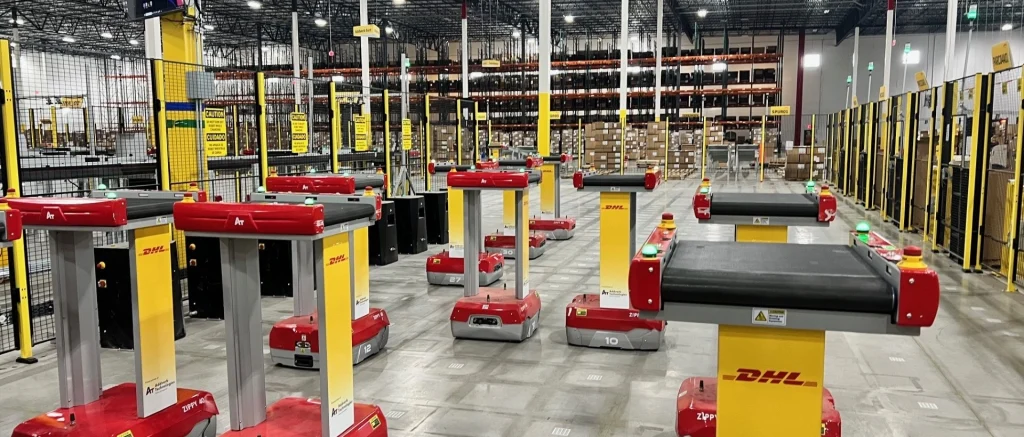
Technology: * AMRs (Autonomous Mobile Robots): Unlike old conveyors, these navigate freely using LiDAR.
AS/RS (Automated Storage and Retrieval Systems): High-density cranes and shuttles that utilize vertical space humans can’t reach.
Cobots: Robotic arms with computer vision that can pick individual items (piece-picking) with “hand-eye” coordination.
Workflow: “Goods-to-person.” Instead of a human walking to a shelf, the shelf (carried by a robot) walks to the human.
Mitigating Factors: Why the Change?
Several “forcing functions” accelerated this transition from muscle to machine:
| Factor | Impact on Strategy |
| The “Amazon Effect” | Consumer expectations shifted from “7-day shipping” to “same-day.” Muscle simply cannot move fast enough to meet these deadlines. |
| Labour Shortages | Warehousing is physically demanding. In many regions, the “Muscle” is hard to find and retain, making automation a necessity rather than a luxury. |
| Real Estate Costs | As land prices rose, warehouses had to grow up, not out. Mechatronics allow for high-density storage that human-operated forklifts cannot safely navigate. |
| Data & SKU Proliferation | A modern centre might manage millions of unique items. Humans can’t track that complexity on paper; you need an “electronic brain” to optimize the chaos. |
| Safety Regulations | Moving heavy pallets is dangerous. Automating the most hazardous tasks reduces insurance premiums and workplace injuries. |
A Quick Reality Check: While we talk about “Mechatronics,” don’t picture a lights-out factory just yet. Most modern centres are hybrid environments where humans handle the complex problem-solving and robots handle the repetitive, ergonomic strain.
2. The Amazon & DHL Blueprint: Automation in Action
Europe and the UK are currently the primary “test labs” for the most advanced mechatronics because the mitigating factors—specifically labour costs, land scarcity, and strict ergonomic regulations—are even more intense there than in the USA. The strategies aren’t just relevant; they are being driven by European innovation hubs. Here is how the “Blueprint” translates to the UK and European markets:
Amazon in Europe: The “Symphony” Strategy
Amazon has invested over €700 million in its European fulfillment network recently. Their European headquarters for robotics is the Operations Innovation Lab in Vercelli, Italy, and they have a massive Last Mile Innovation Centre in Dortmund, Germany.
Equipment unique to or piloted in Europe:
The “Universal Robotic Labeller” (URL): Developed to handle the high variety of European package shapes. It uses high-speed computer vision to apply labels to irregular surfaces.
Automated Tote Retriever (ATR): A shuttle system that runs on rails to automate the movement of full bins (totes), reducing the need for workers to lift heavy plastic containers.
Robotic Tote Palletizer (RTP): Used extensively in UK centres (like Stockton-on-Tees and Northampton). Two robotic arms work in harmony to stack totes into double-stacked pallets.
The “Mechatronics” Workforce: In the UK, Amazon has launched specialized apprenticeship programs to train “Mechatronics Engineers”—a direct response to the shift from muscle to machine.
DHL Supply Chain: The “Open Integrator” in the UK & EU
DHL’s European strategy is focused on Strategy 2030, which involves a £550 million investment specifically for the UK and Ireland. Unlike Amazon, DHL uses European and Global “Best-of-Breed” suppliers.
Key Equipment & European Suppliers:
Locus Robotics (LocusBots): Heavily deployed in the UK. DHL recently added 1,000+ additional robots to their UK operations to support e-commerce and life sciences.
Exotec (French): Their Skypod system (the vertical climbing robots) is a European favourite. DHL uses these in high-density facilities where land is expensive (e.g., near London or Paris).
Boston Dynamics (Stretch): DHL was the first to commercially deploy “Stretch” in the UK for unloading shipping containers—a notoriously difficult “muscle” job at ports like Felixstowe.
Effidence (French): They supply the EffiBOT, a “follow-me” robot used in DHL’s European warehouses to help human pickers carry heavy loads without needing to push a trolley.
3. Top European Manufacturers (The “Mechatronics” Giants)
While Amazon builds its own, most other European companies (Tesco, Zalando, Ocado) buy from these “Big Three” European mechatronics powerhouses:
| Manufacturer | Nationality | What they provide |
| Swisslog (KUKA) | Swiss/German | Known for AutoStore integration and high-speed pallet cranes. |
| KNAPP | Austrian | Specialists in “OSR Shuttle” systems—very popular in European pharmaceutical and grocery sectors. |
| Vanderlande | Dutch | The world leader in baggage handling and parcel sorting (used in almost every major EU airport and parcel hub). |
| SSI SCHAEFER | German | The “muscle-to-machine” veterans, providing everything from steel racking to fully autonomous “Weasel” AMRs. |
Why the UK/EU is leading the charge:
Interestingly, automation isn’t always a choice to cut costs—it’s often a response to a lack of the correct available workers.
Aging Workforce: In Europe, roughly 40% of the current logistics workforce is expected to retire within 15 years.
Wage Inflation: In logistics hubs like the Netherlands and Germany, wage growth (8%+) has shortened the ROI for a robot to less than 18 months. Automation is filling the gap left by a shrinking labour pool rather than purely displacing existing workers.
Strict Ergonomics: EU “Manual Handling” regulations are very strict. Robots are often brought in not just for speed, but because it is legally difficult to ask a human to perform certain repetitive lifts.
Energy Efficiency: European mechatronics (like AutoStore) are designed to be “dark”—operating without heat or light to meet EU Green Deal energy standards.
The “Warehouse of the Future” (2026): Amazon plans to launch its first “fully operational delivery station of the future” in Europe by the end of 2026, featuring almost zero manual sorting.
Key Insight: The “Blue-Collar Renaissance” means that while there are fewer roles for “unskilled” labour, the roles that remain are higher-paying, safer, and require a technical “trade” certificate in robotics or systems management.
The Displacement of “Low-Complexity” Tasks
In the traditional warehouse, an entry-level worker needed a pair of boots and a strong back to move boxes. Today, that same person needs to understand warehouse management systems (WMS), interact with cobots (collaborative robots), and troubleshoot basic hardware. Automation targets the repetitive, high-strain tasks that used to be the bread and butter of new hires.
The Old Entry-Level: Spending 8 hours a day walking miles of aisles to pick items or palletizing heavy boxes.
The New Reality: AMRs (Autonomous Mobile Robots) handle the travel, and robotic arms handle the heavy lifting.
The Result: The “easy” starting jobs are gone. The remaining roles require higher cognitive engagement from day one.
The Rise of the “Robot Whisperer”
We are seeing a upskilling squeeze. Even the lowest-tier workers are now tech-adjacent.
Human-Machine Collaboration: Workers no longer just “pick”; they manage a fleet of 5–10 robots that bring shelves to them (Goods-to-Person).
Interface Management: Entry-level staff must navigate complex tablet interfaces and interpret real-time data to ensure the flow of the warehouse isn’t interrupted.
The “Experience Paradox”
This shift creates a hurdle for both employers and seekers:
Higher Barriers to Entry: Companies now look for “digital literacy” as a baseline requirement.
Training Burden: Because schools aren’t yet teaching “Warehouse Robotics 101,” companies have to invest heavily in specialized training, making the hiring process more expensive and selective.
Career Path Compression: The gap between a floor worker and a technician is shrinking. An entry-level employee might be promoted to a “Superuser” or “System Lead” much faster than in the old manual days.
The “death” of warehouse isn’t about a lack of jobs; it’s about the death of the low-skill ceiling. In an automated warehouse, the entry-level role is essentially a junior technician role. This is great for long-term wages and safety, but it’s a challenge for the millions of workers who aren’t tech-savvy. You might want to frame it as the “Professionalization of the Warehouse Floor.”
The Rise of the “New Trades”
The demand for traditional trades has evolved into a need for “Mechatronics” and “Robotics Technicians.” This is where the most significant labour growth is occurring.
In-Demand Skills for 2026:
AMR Technicians: Maintenance of Autonomous Mobile Robots (AMRs) is now a core trade. These workers need to understand sensor calibration, drive system repair, and “Edge AI” troubleshooting.
- Control Systems Specialists: Companies like DHL are investing heavily (over £550m in the UK alone) in infrastructure that requires tradespeople skilled in PLC (Programmable Logic Controller) programming and industrial networking.
- Predictive Maintenance: Instead of fixing machines when they break, tradespeople now use AI-driven dashboards to identify potential failures before they happen.
Reskilling: Who Is Paying for the Transition?
In the UK and Europe, the financial burden is distributed across a “triad of investment”: the state, the employer, and (increasingly) the technology providers themselves the reskilling programme is not regarded as a single expense, but as a co-funded ecosystem.
The Public Sector: Government-Led “Bootcamps”
Governments are treating warehouse automation as a matter of national economic security. They pay to prevent “technological unemployment.”
United Kingdom: The Department for Education’s Skills Bootcamps are a primary vehicle. For an automated logistics firm looking to upskill its staff, the government covers 70% to 90% of the cost. Small-to-medium enterprises (SMEs) only pay a 10% contribution, while larger firms pay 30%.
European Union: The Pact for Skills and the European Social Fund+ (ESF+) are the main engines. These funds are heavily targeted at the “Twin Transition” (Green and Digital). In 2026, many of these grants are channelled through regional innovation hubs that offer subsidized training in robotics and AI-driven inventory management.
The Private Sector: “Buy or Build” Strategy
Large-scale logistics players (like Amazon, DHL, or Ocado) often find it cheaper to “build” talent than to “buy” it from a thinning talent pool.
Internal Academies: Major firms are moving away from one-off training sessions toward permanent internal universities. They pay for this out of their R&D or Operational budgets, viewing it as capital expenditure (CapEx) similar to buying the robots themselves.
Apprenticeship Levies: In the UK, large employers pay an Apprenticeship Levy (0.5% of their annual pay bill). Smart companies are now reclaiming this “lost” money to fund advanced Level 4 and 5 apprenticeships in Automation Engineering and Data Analytics.
The Tech Vendors: “Training as a Service”
A significant shift in 2026 is that the manufacturers of the automation hardware (the AGVs, cobots, and sorting systems) are now including reskilling in their sales contracts.
Embedded Training: When a warehouse purchases a £10M automation suite from a vendor like Daifuku or Dematic, the contract often includes “Lifetime Training” for a core team of operators.
Certification Ecosystems: Companies like Siemens and Bosch Rexroth have established their own certification tracks. They often subsidise these courses to ensure there are enough qualified technicians in the market to maintain their specific machines.
The Workers: Sweat Equity vs. Financial Cost
| Funding Source | Typical Contribution | Best For… |
| UK Skills Bootcamps | 70% – 90% Government funded | Rapid upskilling in AI & HGV tech. |
| EU Pact for Skills | Grant-based (variable) | Cross-border digital & green logistics. |
| Apprenticeship Levy | 100% Employer-funded (via tax) | Long-term engineering/management roles. |
| Vendor Contracts | Included in hardware cost | Maintenance and machine-specific skills. |
CONCLUSION: The “Who Pays?” question is shifting. It is no longer just the boss’s responsibility; it is a collaborative investment where the state provides the foundation, and the company provides the specific application.
The Human-Centric Future: Addressing the “Fear of Replacement”
The most successful logistics firms in 2026 aren’t those with the most robots, but those with the best Human-Robot Collaboration (HRC) and the narrative has altered from “robots taking over” to “robots as partners”, this then is the most effective way to address the current industry sentiment.
From “Lifting” to “Leading”: Automation is largely absorbing the “3D” tasks—Dull, Dirty, and Dangerous. This shifts the human role from manual labour to Workflow Orchestration. Workers are becoming “Fleet Supervisors,” using tablets to manage a dozen Autonomous Mobile Robots (AMRs) rather than pushing a heavy cart themselves.
The Reinstatement Effect: While some roles disappear, new ones are created. We are seeing a surge in demand for Automation Technicians, Data Analysts, and Exception Handlers—people specifically trained to step in when a robot encounters a scenario its AI hasn’t seen before.
Upskilling as a Benefit: Companies are now offering “Robotic Literacy” programs. Instead of being replaced, workers are being upskilled to maintain and program the very systems they once feared, often leading to higher pay and better physical longevity in the workforce.
The Technical Challenges: The “Hidden” Hurdles
Implementing these systems isn’t as simple as “unboxing” a robot, there is the technical reality that often stays behind the scenes and in fact does not surface until a later moment. This is why planning, measurements on the ground/site {rather than just on the CAD/CAM) is vital for a smooth installation.
A. The Integration Nightmare (Legacy vs. Modern)
Most warehouses weren’t built for 2026 tech, the introduction of the RaaS (Robotics as a Service) is a huge trend in 2026 that allows companies to “rent” robots, which helps solve the high initial investment cost that are mentioned in the above technical challenges section. This enables smaller companies with sometimes older ” Brownfield” sites to install an Automated line but as explained this can carry certain problems marrying up to existing equipment and buildings.
Connectivity Dead Zones: Massive steel racks and concrete walls create “Wi-Fi shadows” that can cause a robot to freeze mid-aisle.
Software Silos: Getting a new robotic fleet to “talk” to an 15-year-old Warehouse Management System (WMS) often requires complex middleware or custom API development that can delay projects by months.
B. Facility Infrastructure & “Floor Physics”
Surface Tension: Many AMRs require perfectly level, polished concrete to operate at top speed. Older warehouses with cracked floors or steep ramps require significant (and expensive) civil engineering before a single robot can be deployed.
Power Density: A fleet of 50 robots needs massive charging infrastructure. Many facilities find their existing electrical grids aren’t equipped to handle the simultaneous “fast-charging” demands of a robotic workforce.
C. The Complexity of the “Pick”
While robots can move pallets easily, High-SKU Variability remains a challenge. A robot that can pick a box of sneakers might struggle with a poly-bagged shirt or a glass bottle. Achieving “Human-level dexterity” across millions of different shapes and weights is still the “Holy Grail” of warehouse tech.
The Balanced Ecosystem
To sum up, we have to acknowledge there are a lot of “Pros & Cons” in implementing this automation and technology, not least the effect it has on the working humans in terms of unemployment factors, safety and mental stability. We have to accept and emphasise that the future is an ecosystem, not a takeover. The automated warehouse of the future isn’t a ‘lights-out’ facility where humans are absent; it’s a high-tech hub where AI manages the rhythm, robots handle the weight, and humans provide the critical thinking and adaptability that no algorithm can yet replicate.