On Your Tools

Skilled Workers – Blue Collar Workers

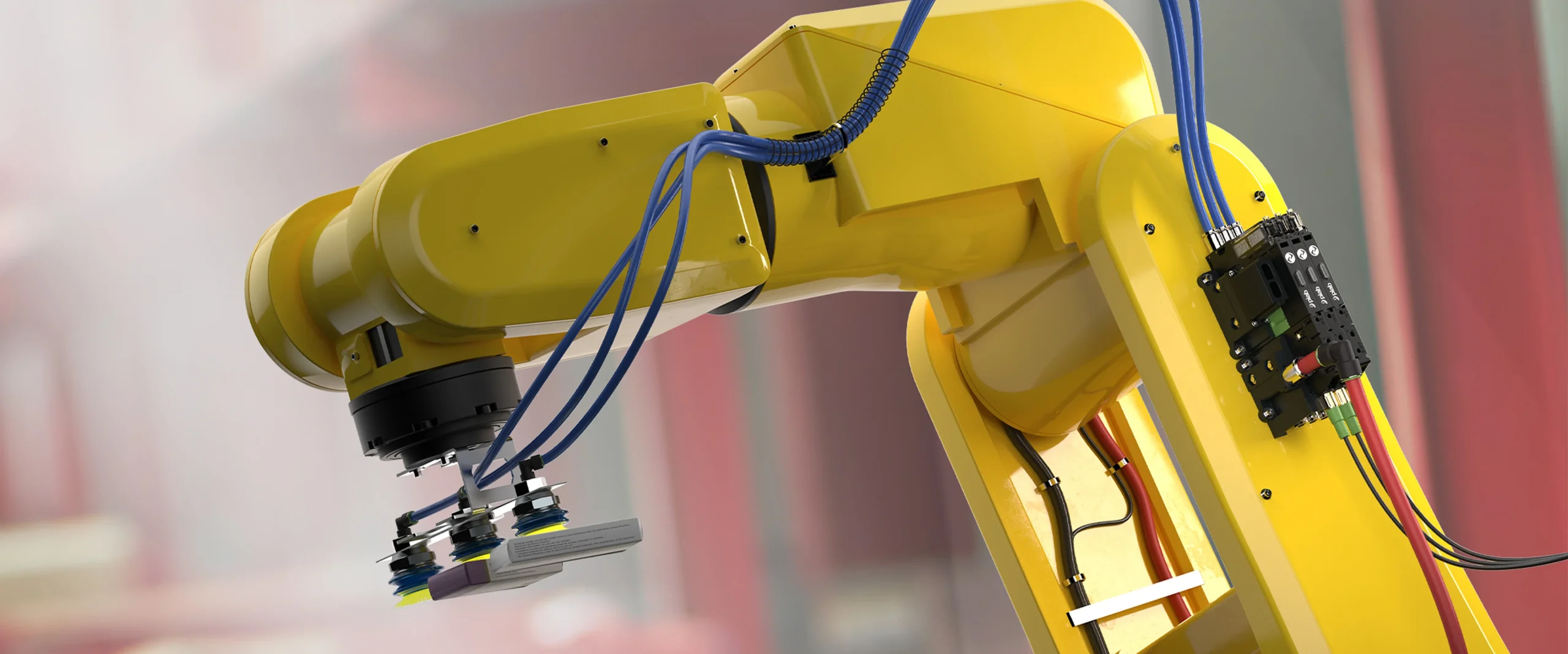
Vacuum Generators – The Lungs of the Robotics System

PIAB Vacuum G.enerator for use in the Robotics & Automation fields

In the world of robotics, precision is often measured in millimetres, but strength is often measured in atmospheres. While mechanical grippers and soft robotics grab headlines, the unsung hero of high-speed pick-and-place operations remains the vacuum generator. These compact powerhouses are the LUNGS of an automated system, converting compressed air or electrical energy into the negative pressure required to lift everything from delicate silicon wafers to heavy automotive panels. Whether you are building a collaborative workspace or a high-speed packaging line, understanding the mechanics of vacuum generation is the first step toward achieving a truly seamless “grip and go” workflow. Before we dive deeper into the operation and design of the generator we need to talk about the Blood (air supply).

Why “Clean Air” is the Foundation

Before the vacuum generator can create a pressure differential to lift a part, it relies on a steady stream of compressed air (for Venturi-style generators). If that air isn’t treated, you run into three major “blog-worthy” problems:

  1. Orifice Clogging: Most robotic vacuum generators use tiny nozzles to create the Venturi effect. A single speck of dust or a drop of oil can choke the flow, leading to dropped parts on the assembly line.

  2. Seal Degradation: Moisture in the lines causes internal seals to swell or crack, leading to air leaks and “vacuum drop,” which is a nightmare for precision robotics.

  3. Sensor Failure: Modern robotics use vacuum switches to “confirm” a part has been picked up. Contaminated air can gum up these sensors, giving the robot false readings.

The “Triple Threat” of Air Preparation

So lets introduce the  FRL Unit, which is the gatekeeper for any pneumatic robotic cell, the filtration system that cleans the air before it hits the lungs. this can be explained as these three stages:

  • Filtering: Removing particulates and water aerosols.

  • Regulating: Ensuring the vacuum generator receives a consistent pressure. Fluctuating pressure equals fluctuating suction power.

  • Lubricating: (Note: This is a great  ” PRO TIP “   Many modern vacuum generators actually require non-lubricated air. Using an old-school lubricator can actually ruin the vacuum diaphragms! Always best to check with the pneumatic fitting manufacturers before proceeding with the installation of the Air Supply. This is a job for the Project Engineer.

Transitioning to the Vacuum Generator

Well what decides if we are ready for the next stage, In industrial automation, “clean air” isn’t a subjective term; it’s a legal and technical specification. For Festo or Piab systems to meet their warranty and performance specs, the air usually needs to meet ISO 8573-1:2010 Class 4 or 5 for particles and moisture.

 Europe and the UK are often the primary drivers for these standards. I SO 8573-1:2010: This is an International Standard. It is used as the benchmark for air quality in the UK (BS ISO 8573-1) and throughout the EU. If a factory in Birmingham or Berlin is running a Festo or Piab system, the maintenance manual will almost certainly specify an air purity class based on this ISO standard.

Why it’s “the law” in automation: Most high-end vacuum generators (like the Festo OVEM) are packed with sensitive internal solenoid valves. If you use “wet” or “oily” air, the internal lubricants of those valves degrade. This can lead to CE marking or UKCA compliance issues if the machine fails to operate within its safety or performance specifications.

Why it matters: In an automation line, “dirty” air doesn’t just break the generator; it causes inconsistent cycle times. If the vacuum takes 100ms longer to build because of a partially clogged nozzle, the entire robot’s timing is thrown off, leading to “collision” or “missed pick” errors. In summary, neglecting air quality is a false economy. The cost of proper air filtration and drying equipment is generally minor compared to the cost of production downtime, replacement parts, and maintenance labour that result from using contaminated air.

Remember, Vacuum generators are essentially  “transducers”— they aren’t creating energy; they are simply converting the energy of high-pressure/low-velocity air into low-pressure/high-velocity air.

High-Speed Pick and Place Efficiency

Industrial lines care about Air Consumption vs. Evacuation Time.

  • The Conflict: Dirty air increases friction in the nozzles. This forces the vacuum generator to work harder and consume more compressed air to achieve the same vacuum level (Pa).

  • The Result: You aren’t just losing parts; you’re losing money on energy. Compressed air is one of the most expensive utilities in a factory. A clean supply ensures the generator operates at its peak efficiency curve.

The “COAX®” and “OVEM” Factor

We reach the stage that we are happy we are supplying the best air to our generators and so we have a further choice Both Festo and Piab use the Venturi Effect:  principle which is using fluid dynamics to create suction without moving parts. 

Why the Venturi Effect Matters

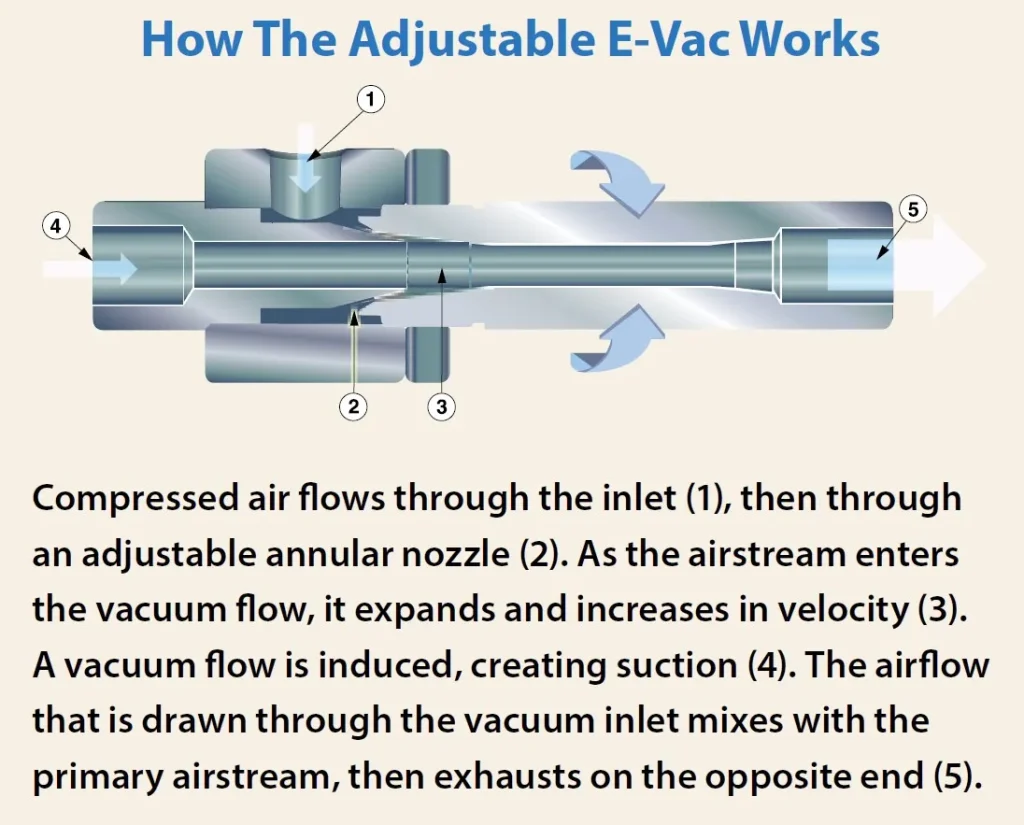
In a vacuum generator (or ejector), compressed air is forced through a narrowed nozzle. As the air constricts, its velocity increases significantly, while its pressure decreases. This creates a low-pressure zone (vacuum) at the point of constriction, which draws in air from the vacuum port.

The Anatomy of a Vacuum Generator

Whether you are looking at a Piab multistage COAX® cartridge or a Festo VN series ejector, the internal logic remains the same:

  1. Compressed Air Inlet: High-pressure air enters the system.

  2. Laval Nozzle: A specifically shaped internal nozzle that accelerates the air to supersonic speeds.

  3. Vacuum Port: The opening where the “suction” occurs due to the pressure drop.

  4. Diffuser: A widening chamber where the air slows down and exhausts, often through a silencer.

Piab vs. Festo: Design Philosophies

While both companies use the Venturi Effect, they often implement it differently:

Piab (Multistage): Piab is famous for multistage technology. Instead of one nozzle, they use a series of nozzles in a row. This allows the generator to move a much higher volume of air (high flow) while maintaining efficiency, making them excellent for porous materials like cardboard.

Festo (Single-stage/Compact): Festo often focuses on highly integrated, compact “plug-and-play” units. Their generators frequently include built-in solenoid valves for “suction” and “blow-off” pulses, which are critical for high-speed robotic pick-and-place cycles.

When talking about Piab, we have to talk about COAX® technology. Unlike simple one-stage venturis, Piab uses multi-stage ejectors.
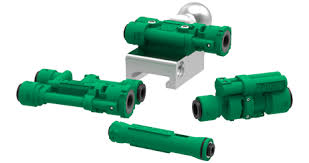
A Selection of Piab Coax Vacuum Ejectors.

The Piab COAX® technology is essentially the “Swiss Army Knife” of vacuum generation. While traditional vacuum ejectors use a single nozzle, the COAX® system utilizes a multi-stage design that makes it significantly more efficient and versatile.

1. Multi-Stage Ejector Design

Standard vacuum generators use a single venturi nozzle. COAX® technology uses a series of nozzles (stages) of different sizes nested inside one another.

  • The Benefit: It allows for a high initial vacuum flow (great for picking up porous materials) while still reaching a deep ultimate vacuum level. It’s like having a high-speed gear and a high-torque gear working at the same time.

2. Extreme Energy Efficiency

Because of the multi-stage design, COAX® cartridges can produce up to twice the vacuum flow of a conventional ejector while consuming the same amount of compressed air.

  • Cost Savings: In high-speed packaging lines where vacuum is constantly cycling, this leads to a massive reduction in factory energy bills.

  • Lower Pressure: They can operate effectively at lower feed pressures (around 0.17 to 0.30 MPa), which reduces wear and tear on the compressor system.

3. Reliability and Speed

  • No Moving Parts: Since it relies on fluid dynamics rather than mechanical pumps, there is very little that can break or wear out.

  • Fast Response: Because the cartridges are small and lightweight, they can be mounted directly at the point of use (right on the suction cup). This eliminates the “dead volume” of long hoses, leading to much faster grip and release cycles.

4. Modular and Compact

The “Special Sauce” is the cartridge format. Instead of a bulky machine, the vacuum generator is a small, replaceable cylinder.

  • Scalability: You can easily swap cartridges to change performance characteristics (e.g., switching from a high-flow cartridge for cardboard to a high-vacuum cartridge for steel).

  • Integration: They are small enough to be integrated directly into the body of a robotic gripper or a manifold.

Performance Comparison

FeatureConventional EjectorPiab COAX®
Air ConsumptionHighLow (up to 50% less)
Response TimeSlower (due to hose length)Instant (point-of-use)
MaintenanceFrequent (moving parts)Virtually zero
SizeBulkyUltra-compact/Modular

PRO TIP:  If you are working with porous materials like wood or recycled cardboard, the COAX® “Pi” or “Si” cartridges are usually the go-to because they handle the “leaky” nature of those materials without losing grip.

While Piab focuses on the physics of the nozzle (COAX®), Festo’s OVEM and OVEL series are famous in robotics for their integrated intelligence and all-in-one footprint. In a robotics scenario, these aren’t just vacuum generators; they are “plug-and-play” control modules that talk back to the robot’s PLC (Programmable Logic Controller).

1. The FESTO OVEM: The “Smart High-End” Choice

The OVEM is designed for heavy-duty industrial robotics where downtime is expensive.

  • Fully Integrated Unit: It combines the vacuum ejector, two solenoid valves (one for vacuum “on,” one for a “pulse” to drop the part), a filter, a pressure sensor, and a check valve into one block.

  • Condition Monitoring: This is the “special” part. It monitors the vacuum level in real-time. If the suction cup is worn out or a part is slipping, it sends a signal to the robot before the part drops.

  • Air Saving (Automatic): It features an air-saving circuit. Once it reaches a certain vacuum level, it shuts off the compressed air and holds the part using a check valve. It only “sips” air if the vacuum level starts to dip.

2. The OVEL: The “Lightweight/End-of-Arm” Choice

The OVEL is the “little brother,” specifically designed for high-speed Pick & Place and Cobots.

  • Extreme Low Mass: Weight is the enemy of robot speed. The OVEL is incredibly light and compact, meaning you can mount multiple units directly on a small robotic arm without exceeding its payload.

  • Fast Ejection Pulse: In high-speed robotics, you don’t just want to “let go” of a part; you want to “shoot” it off. The OVEL has a dedicated solenoid for a powerful blow-off pulse, ensuring the part is released instantly so the robot can move to the next cycle.

  • IO-Link Integration: Both series use IO-Link, which allows the robot to change vacuum parameters (like “what pressure is considered a success?”) on the fly via software, rather than someone having to manually turn a screw on the tool.

Comparison: Which one for your Robot?

FeatureOVEM (The Powerhouse)OVEL (The Sprinter)
Primary UseHeavy industrial, high-value partsHigh-speed Pick & Place, Cobots
IntelligenceFull LCD display + DiagnosticsLED status + IO-Link
IntegrationAll-in-one (Valves, Filter, Sensor)Minimalist/Compact
EnergyMax Air-Saving capabilitiesFocus on speed/weight

Why they are “Special” for Robotics

If you use a “dumb” vacuum generator, the robot just assumes it has the part. If the part drops, the robot keeps moving, wasting time or causing a crash.

With the OVEM/OVEL, the generator acts as a sensor. It tells the robot: “I have the part, it is secure, you are cleared to move at 100% speed.” This feedback loop is what makes them the gold standard for automated assembly lines.

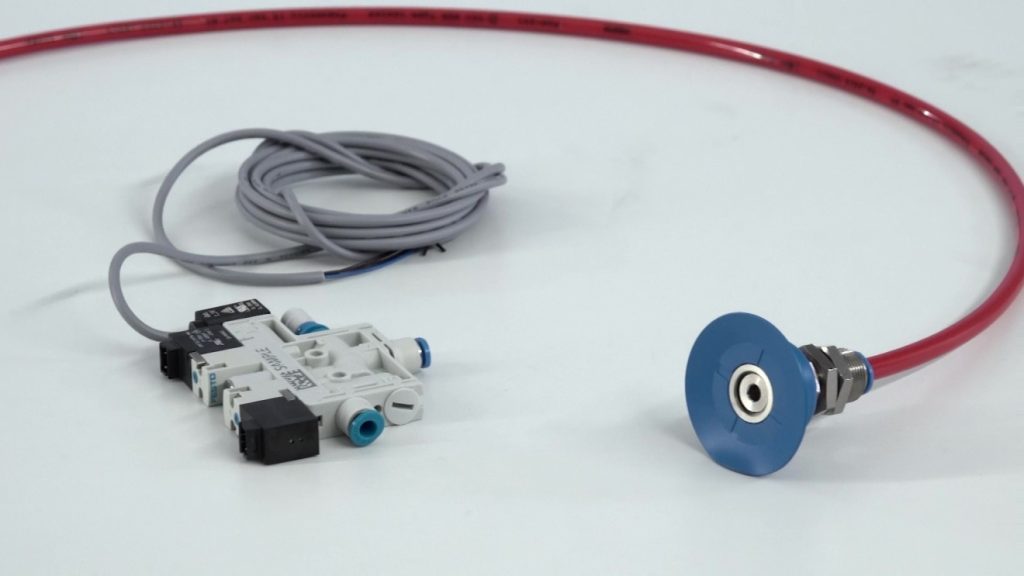
FESTO OVEM Vacuum Generator with Suction Cup Attachment.

While Piab and Festo are massive in Europe, they aren’t the only sharks in the water. In industrial robotics, there is a “Big Four” that dominates most production lines: Robotics Engineers must ensure that they get well trained up on the equipment been installed in their factories, and its of prime importance that the Engineering Division receive and order all the relevant Technical Manuals so that the Engineers/Electricians can keep the operation running. 

Who are the “Global Giants” ?

BrandReputationWhy they matter.
PiabThe Efficiency KingsSwedish-based. Famous for COAX® technology (multi-stage ejectors). They are the go-to for energy efficiency and high-speed packaging.
FestoThe Integration MastersGerman-based. Known for Plug-and-Work solutions. Their vacuum generators often come with everything (valves, sensors, filters) in one “smart” block.
SchmalzThe Handling ExpertsGerman-based. Arguably the world leader in vacuum gripping and manual handling. If a robot is lifting a heavy car windshield or a porous wooden board, it’s likely using Schmalz.
SMCThe Global PowerhouseJapanese-based. They have a massive market share globally. Their vacuum generators (like the ZK2 series) are incredibly common in electronics and semiconductor assembly.

TWO Other Mentions:   Zimmer Group: Huge in “End-of-Arm Tooling” (EOAT) for heavy-duty automotive robots &  Gast / Thomas: More focused on the actual vacuum pumps (mechanical) rather than venturi generators.

CONCLUSION 

 “While Piab (Sweden) and Festo (Germany) are titans of European automation, they represent a global standard of vacuum technology alongside players like Schmalz and SMC, all of which require ISO 8573-1 compliant air to survive the rigors of a 24/7 production line.”

  • Piab is often the choice when air consumption is the #1 priority (their multi-stage cartridges are incredibly efficient).

  • Festo is often the choice when “Digitalization” and “Industry 4.0” are the goals, as their units integrate seamlessly into PLC environments (like Siemens or Rockwell) via IO-Link.

The Growing market for electric vacuum generators

 There is a rapidly growing market for electric vacuum generators, and they are often the preferred choice for collaborative robots (cobots) and mobile platforms. Unlike pneumatic venturi systems that rely on a constant supply of compressed air, these units use an internal electric motor to drive a small pump or fan. Leading manufacturers include the very brands that we have already researched in the Pneumatic Generators: Piab, Festo, and Schmalz, along with specialist cobot tooling brands like OnRobot.

Key Manufacturers and Their Models

Most electric generators are designed as “Plug & Play” units that mount directly to the robot’s wrist (End-of-Arm Tooling).

Piab (piCOBOT® Electric): A fully electric version of their famous piCOBOT. It’s highly energy-efficient and designed to work without any air hoses, making it ideal for cobots with internal cable routing.

Schmalz (CobotPump ECBPMi): One of the most common electric generators. It is extremely compact and uses an integrated NFC interface for configuration via smartphone.

OnRobot (VG10 / VGC10): These are industry favorites because they are entirely self-contained. They don’t just generate vacuum; they are complete “Octopus” style grippers with adjustable arms.

Festo (ECBP): Festo’s electric vacuum generator is specifically optimized for handling airtight workpieces in constrained spaces where running air lines would be difficult.

Is an Electric Generator “Better”?

There is no “perfect” choice; it depends entirely on your application’s requirements for payload, environment, and infrastructure.

Comparison: Electric vs. Pneumatic (Venturi)

FeatureElectric GeneratorPneumatic (Venturi)
InfrastructureOnly requires 24V power.Requires compressed air lines.
MobilityIdeal for mobile robots (AMRs).Tethered by air hoses.
Energy CostVery low (only uses power when active).High (compressed air is expensive).
Payload/ForceGenerally lower (up to 15–20kg).Very high (limited only by air supply).
Cycle SpeedSlower (pump must “spool up”).Instant (venturi effect is immediate).
DurabilityModerate (mechanical pump wear).Extremely high (no moving parts).
EnvironmentSensitive to dust/heat.Can handle harsh/ATEX environments.

When to Choose Electric

The following circumstances would suggest that Electric Generators should be seriously considered over pneumatic 

Mobile Robotics: Where trailing a heavy air hose is impossible.

Cleanrooms: Where exhausting “dirty” compressed air into the room is prohibited.

Low-Infrastructure Sites: Warehouses or labs that don’t have a built-in compressor system.

Energy Efficiency Initiatives: Electric generators consume up to 90% less energy than pneumatic ones because they don’t suffer from the massive efficiency losses inherent in air compression.

wpx_

Apprenticeship trained Mechanical Technician, worked in many Blue Chip Companies including Glaxo Smithkline, Reckitts Benckiser, Unilever, Coca Cola mainly in the UK but also in Europe.

Leave a Comment