On Your Tools

Skilled Workers – Blue Collar Workers

Discover 7 Booming Sectors that require Skilled Trades people.

7 Best Booming Sectors suitable for Skilled Trades people.

DISCOVER 7 High Earning Jobs for Skilled Workers to Embark upon today.

For decades, the standard advice for success was clear: get a four-year degree or prepare to settle for less. But in 2026, the script has flipped. As artificial intelligence reshapes the white-collar landscape and the global infrastructure demand hits an all-time high, the real ‘gold rush’ isn’t happening in a cubicle—it’s happening on the front lines of the modern industrial world. From the humming servers of massive data centres to the towering blades of wind farms and the complex precision of robotics, skilled workers are now outpacing their university-educated peers in both job stability and salary potential. If you’re ready to trade the burnout of the desk life for a high-tech, high-impact, and high-paying career, it’s time to look at the seven industries currently fuelling the future.

 Given the current labour market shift in 2026, positioning this as a “gold rush” is exactly right—it’s not just about “jobs,” it’s about career sovereignty and long-term financial security. We are having a Deep Dive into the major shift in the 2026 labour market where “New Collar” and high-tech blue-collar roles are outpacing traditional office work in both salary growth and job security.

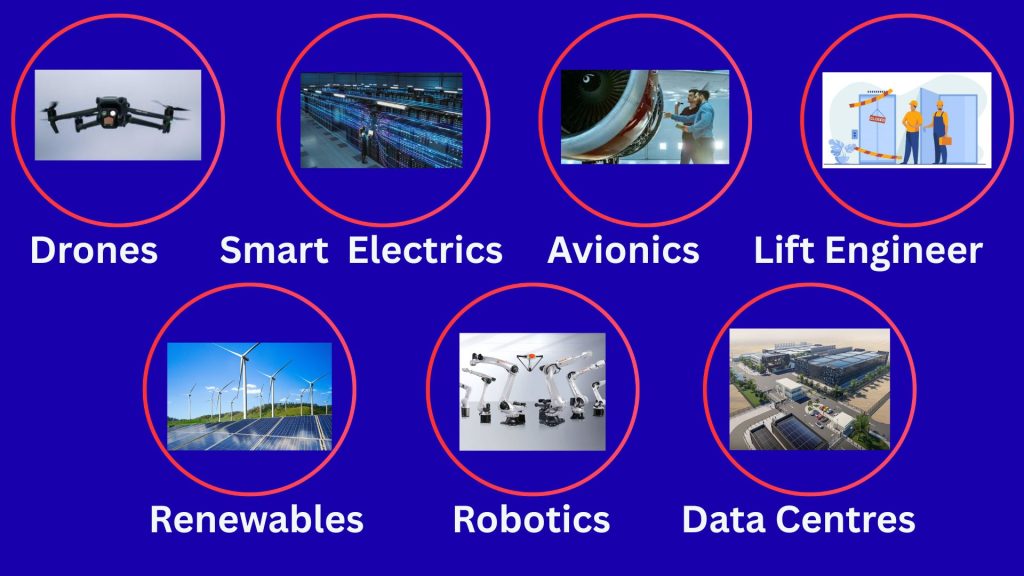
7 Most Promising & High-Paying Industries (2026)

Based on current economic trends and the “AI-proofing” of the workforce, these seven sectors are the heavy hitters:I

IndustryHigh-Demand Job Title2026 Salary Estimate
Data CentresCritical Facilities Technician (HVAC/Electrical)Euro 90k – 130k+
RoboticsMechatronics/Robotics Systems IntegratorEuro 85k – 125k
Renewable EnergyWind Turbine or BESS (Battery) SpecialistEuro 70k – 110k
Drone TechnologyIndustrial UAV Pilot & Data TechnicianEuro 80k – 150k*
Smart InfrastructureEV Infrastructure / Smart Grid ElectricianEuro 80k – 120k
Aerospace/DefenceAircraft Avionics & Composite TechnicianEuro 95k – 140k
Vertical TransportElevator & Escalator Modernization TechEuro100k – 160k

1. DATA CENTRES  (UK & EUROPE)

The “Digital Backbone” of the AI Era

In 2026, the Data Centre sector has entered an “industrialization” phase. Driven by the explosive demand for Generative AI and cloud sovereignty, the industry is seeing record-breaking investment, with the UK remaining the largest market in Europe. For skilled workers, this is a “gold rush” era where technical expertise in power, cooling, and infrastructure command some of the highest premiums in the job market.

Key Trends for 2026

  • The AI Supercycle: Data centres are being completely redesigned to handle AI workloads. This has shifted the focus from traditional storage to high-density compute, requiring innovative liquid cooling and advanced power management systems.

  • Regional “AI Growth Zones”: While London remains the dominant hub, 2026 is seeing a shift toward regional diversification. In the UK, areas like Manchester, South Wales, and Scotland are emerging as “Growth Zones” due to better grid access and land availability. Across Europe, the “FLAPD” cities (Frankfurt, London, Amsterdam, Paris, Dublin) are expanding into secondary markets like Madrid, Warsaw, and Milan.
  • The Sustainability Mandate: Stricter EU and UK regulations (like the 2026 EU Data Centre Energy Efficiency Package) have made Sustainability Specialists and Energy Engineers indispensable. Facilities must now prove their “green” credentials through waste-heat recovery and carbon-neutral operations.

High-Paying Roles in Demand

The current talent shortage is driving salaries to historic highs, with many senior roles exceeding £100,000 / €120,000.

Critical Infrastructure Engineers: Specialists in MEP (Mechanical, Electrical, and Plumbing) who can manage complex liquid cooling and high-voltage power systems.

Data Centre Operations Managers: Professionals who oversee the uptime and physical security of multi-megawatt campuses.

Sustainability & Energy Consultants: Experts who can navigate the complex web of energy procurement and carbon reporting.

AI Infrastructure Specialists: Engineers focused on the hardware side of AI, including GPU clusters and specialized networking fabric..

 The shift from traditional air cooling to Liquid Cooling has turned data centres into massive, complex plumbing systems. This has fundamentally shifted the “high-paying” landscape toward mechanical trades that were once associated more with oil rigs or nuclear plants than with tech hubs.

The Mechanical Revolution: Cooling the AI Heat

The sheer heat generated by AI-optimized GPU clusters (like those used for Large Language Models) has made traditional fans and air conditioning obsolete for high-density racks. Most new European builds in 2026 utilize Direct-to-Chip (DTC) or Immersion Cooling, creating a massive demand for precision mechanical skills.

1. High-Precision Pipefitters

Data centres now require intricate networks of stainless steel and copper piping to transport dielectric fluids or chilled water directly to the server racks.

  • The Skill Shift: Unlike standard commercial HVAC, data centre pipefitting requires “cleanroom” standards. A single leak can destroy millions of pounds worth of hardware.

  • Why it pays: Pipefitters with experience in BIM (Building Information Modelling)—allowing them to read 3D digital twins of the facility—are commanding significant premiums.

2. Specialised Welders (TIG & Orbital)

Since these cooling loops operate under pressure and often involve sensitive fluids, the quality of the welds must be flawless.

  • The Skill Shift: There is a specific surge in demand for TIG (Tungsten Inert Gas) Welders and specialists in Orbital Welding. These techniques provide the high-purity, high-strength joins required for leak-proof cooling loops.

  • Certification: Welders with ISO or ASME pressure vessel certifications are seeing their rates skyrocket as data centre operators compete for a limited pool of talent.

3. Thermal Management Technicians

This is a hybrid role that didn’t exist in the “Cloud” era but is essential in the “AI” era.

  • The Role: These workers bridge the gap between plumbing and IT. They monitor flow rates, pressure differentials, and “Delta T” (the temperature difference between the fluid entering and leaving the rack).

  • The Skill: Understanding the chemistry of cooling fluids—ensuring they don’t become corrosive or contaminated—is now a core competency.

4. Non-Destructive Testing (NDT) Technicians

Because a leak is a catastrophic failure, 2026 has seen a rise in NDT roles within the sector. These professionals use ultrasound or X-ray technology to inspect welds and pipe integrity without damaging the system.

So opportunities are present for workers in the UK and Europe, these roles offer a unique advantage: they cannot be outsourced or automated by AI. You cannot “remote-in” to weld a pressurised cooling loop or fit a manifold to a server rack. The “Digital” economy is becoming increasingly “Physical”, the people who keep the servers cold are just as vital—and often as well-paid—as the people who write the code. This is the transfer and amalgamation that former “Blue Collar” skills are being rebranded as “Skilled Trades” or “New Collar.” This resonates very well with younger workers (Gen Z) who are currently entering trade schools at record rates to avoid student debt.

2.Renewable Energy (Wind & Solar) The “Green Boom” of 2026

The renewable energy sector is currently experiencing a massive surge, driven by three main factors:

  • Grid Modernization: To handle the influx of solar and wind, the entire electrical grid is being overhauled. This requires a massive new workforce to build and maintain the smart grid.

  • Data Centre Demand: The explosion of AI and cloud computing has created a desperate need for “round-the-clock” clean energy, leading to record-breaking investments in solar-plus-storage projects.

  • Energy Independence: Governments are prioritizing local energy production to avoid global supply chain shocks, resulting in aggressive tax incentives and “must-build” targets for 2027 and beyond.

Essential Skilled Workers in 2026

1. Wind Turbine Service Technicians

Often called “Wind Techs,” these professionals are the modern-day cowboys of the energy world.

  • The Role: They climb hundreds of feet to inspect, troubleshoot, and repair the mechanical and electrical components of massive turbines.

  • Why it’s Booming: Wind capacity is projected to grow by nearly 50% over the next decade. There is a critical shortage of techs who can handle the complex hydraulics and fiberglass repair required.

2. Solar Photovoltaic (PV) Installers

Solar isn’t just for rooftops anymore; utility-scale “solar farms” are popping up globally.

  • The Role: Beyond just bolting panels down, these installers must be experts in electrical systems, weather-sealing, and complex tracking technology that allows panels to follow the sun.

  • Why it’s Booming: Solar is currently the fastest-growing occupation in many regions because it offers the shortest “lead time” from construction to power generation.

3. Specialised Renewable Electricians

This isn’t your average residential wiring. These “Green Electricians” specialize in high-voltage DC-to-AC conversion.

  • The Role: They manage the inverters, transformers, and battery storage systems that keep the power steady.

  • Why it’s Booming: Every solar and wind farm needs a Master Electrician to sign off on grid connections. The scarcity of these specialists often pushes salaries well into six figures with overtime.

4. Grid Modernisation Lineworkers

As we move away from coal and gas, we need new “highways” for electricity.

  • The Role: Installing and maintaining the high-voltage transmission lines that carry wind power from remote plains to major cities.

  • Why it’s Booming: Massive infrastructure spending in 2025 and 2026 has made lineworkers one of the most sought-after trades, with many earning over Eu110,000 annually.

FeatureWind Turbine TechnicianSolar PV Installer
Projected Growth (by 2034)~50%~42%
Typical Work EnvironmentExtreme heights, remote locationsRooftops or large open fields
Primary Skill FocusMechanical/Hydraulic/ElectricalElectrical/Structural
Entry BarrierHigh (Safety & Height certs)Moderate (Often OJT)

SUMMARY

The situation with this sector is that there are many Wind Farm sites in the process of been  built and also there are many more that will now coming to the Overhaul and Maintenance period and so skilled trades people will be in big demand.  Many of these roles don’t require a 4-year degree, a 6-month to 2-year technical certificate—coupled with specialised safety training like GWO (Global Wind Organisation)—is often the “Golden Ticket” to these high-paying roles.

3.Robotics & Industrial Automation 

I will not cover this sector in a big way as I have several Blog posts that cover all aspects of this Industry,  as factories become “smarter,” the demand for technicians who can repair and calibrate industrial robots has skyrocketed. Mechatronics is the skills much vaunted in this sector, 

The Four Pillars of Mechatronics Skills

To work in this field in 2026, a technician needs a specialized “multilingual” skill set:

  • Mechanical Systems: Understanding the physical components—gears, linkages, and pneumatics—that allow a machine to move and perform physical work.

  • Electronics & Circuitry: The ability to troubleshoot the sensors, actuators, and wiring that provide the machine with “senses” (like heat, pressure, or vision).

  • Control Systems (PLCs): Mastery of Programmable Logic Controllers. This is the logic layer where you program the machine to follow specific sequences or react to environmental changes.

  • Systems Integration: The “glue” skill. It’s the ability to look at a complex robotic arm or an automated assembly line and understand how the software code translates into a physical 45° turn.

4. Smart Grid & EV Infrastructure

A pivotal evolution in the electrical trade. In 2026, the traditional “sparky” is transforming into a high-tech systems integrator between heavy outdoor construction and delicate digital networking.

The “Electrification of Everything” has moved from a trend to a massive infrastructure mandate and has turned this sector in to a Top Tier Career opportunity.

  • The “EV Gap”: While millions of EVs are hitting the road, the charging infrastructure is still playing catch-up. Governments and private firms are pouring billions into “fast-charging corridors.”

  • Grid Resilience: Our aging power grids weren’t designed for two-way power flow (like a house selling solar power back to the city). This requires an army of electricians to install the “brain” (sensors and smart meters) onto the “brawn” (transformers and lines).

  • The “Specialist Premium”: General electrical work is steady, but EVITP (Electric Vehicle Infrastructure Training Program) certified electricians are commanding a 20-30% pay premium due to the technical complexity of DC fast-chargers.

The Evolution of the Electrician’s Skill Set

In 2026, the required skills for this sector go far beyond pulling wire. To succeed here, an electrician needs to be part IT specialist and part power engineer.

1. High-Voltage DC (Direct Current) Mastery

Most household electricity is AC, but EV batteries and fast chargers live in the world of DC.

  • The Skill: Managing high-efficiency power conversion and thermal management systems that keep ultra-fast chargers (150kW–350kW) from overheating.

2. Network & Communication Integration

A modern charging station is a “connected device.” It needs to process payments, talk to the grid to avoid overloads, and report its status to an app.

  • The Skill: Basics of IoT, cellular signal testing, and fiber optic termination. If the charger can’t “talk,” it can’t “charge.”

3. Load Balancing & Demand Response

Smart grids rely on “load shedding”—the ability to temporarily dim chargers or appliances when the city’s power demand peaks.

4. Civil & Structural Coordination

Unlike indoor wiring, infrastructure work often involves the “big toys.”

  • The Skill: Reading site plans for underground trenching, coordinating with concrete teams for transformer pads, and ensuring ADA-compliant (Americans with Disabilities Act) station layouts.

Career Snapshot: Infrastructure Electrician (2026)

MetricResidential ElectricianInfrastructure & EV Specialist
Typical Pay$60k – $80k$95k – $120k+
Key CertificationJourneyman LicenseJourneyman +  EVITP  /  SAA
Primary ToolMultimeter & Wire StrippersNetwork Tester & Thermal Camera
Work SiteHomes / Small BusinessHighway Hubs / Depots / Utilities

 The National Electric Vehicle Infrastructure (NEVI) funding is peaking in 2026, this means the job security in this specific niche sector is virtually “recession-proof” for the next several years as these multi-year projects roll out.

5. Elevator & Escalator Modernization

As the world’s urban infrastructure ages, a massive wave of vertical transportation systems is reaching the end of its projected 20-to-30-year lifecycle. Rather than pursuing disruptive and costly full-system replacements, property owners and facility managers are increasingly turning to modernization—the strategic upgrading of mechanical and digital components to enhance safety, efficiency, and reliability.

 This creates a high-demand, specialized market for skilled workers who can blend traditional electromechanical trade expertise with modern advancements like IoT-enabled predictive maintenance, energy-efficient regenerative drives, and smart control systems. For professionals in this sector, the opportunity is robust and stable, as they are essential to ensuring that the aging “arteries” of modern high-rise buildings remain compliant, sustainable, and operational in an increasingly vertical world. This remains one of the highest-paying trades (often Eu100k+) due to high specialisation and the constant “upward” growth of urban centres.

To work as an elevator mechanic, you generally need to follow a structured, multi-year path that combines hands-on experience with technical classroom instruction. Because elevator systems are complex and involve significant safety risks, the industry is heavily regulated.

Key Qualifications and Requirements

  • Education: A high school diploma or GED is the standard starting requirement for almost all apprenticeship programs. During high school, taking courses in mathematics (especially geometry and algebra), physics, and any available technical or mechanical drafting classes is highly recommended

  • Apprenticeship: This is the primary way to enter the field. Programs typically last four to five years and include:
  • On-the-job training: Thousands of hours of supervised field work where you learn to install, maintain, and repair systems.
  • Technical instruction: Classroom or online learning covering electrical theory, blueprint reading, mechanical systems, safety codes, and hydraulics.
  • Note: Major programs include those offered by the International Union of Elevator Constructors (IUEC) through the National Elevator Industry Educational Program (NEIEP) or those provided by the National Association of Elevator Contractors (NAEC).
  • Aptitude Testing: Many apprenticeships require applicants to pass an aptitude test (such as the Elevator Industry Aptitude Test, or EIAT) to gauge their mechanical reasoning, mathematical ability, and verbal reasoning skills.

Licensing and Certification:

State Licensing: Many states require elevator mechanics to hold a state-issued license. Requirements vary by location but usually mandate documented hours of experience and passing a state-specific licensing exams.

Certifications: While not always required by law, certifications like the Certified Elevator Technician (CET) or Certified Accessibility and Private Residence Lift Technician (CAT) are highly valued by employers as they demonstrate a high level of competency and commitment to safety standards.

Essential Qualities: Beyond formal training, successful mechanics often possess:

  • Mechanical Aptitude: Comfort using power tools, diagnostic equipment (like multimeters), and reading schematics.

  • Physical Stamina and Strength: The job often involves working in confined spaces, at heights, and lifting heavy components (sometimes up to 200 pounds)

  • Detail Orientation: You must be able to follow precise safety protocols and maintain accurate service records.

6. Specialised Aerospace & Drone Tech

The aerospace sector has entered a “production-grade” era where the demand for skilled labour is no longer driven by prototypes, but by the need to scale and maintain massive fleets of Uncrewed Aerial Systems (UAS). As the industry moves toward BVLOS (Beyond Visual Line of Sight) operations and autonomous urban air mobility, the “skilled worker” profile has split into three distinct, high-growth pillars.

I. UAS Maintenance & Fleet Engineers

Unlike the early days of disposable drones, 2026’s enterprise-grade hardware requires rigorous maintenance cycles.

  • The Role: Workers who can perform fatigue modelling, composite material repair, and sensor calibration.

  • The Skill Shift: You don’t just “fix” a drone; you manage its digital twin. Skilled technicians must now be proficient in hardware-software integration—ensuring that flight controllers, AI navigation stacks, and physical propulsion systems are perfectly synchronized.

2 . Precision Data & Sensor Operators

The value of a drone is no longer in the flight, but in the data.

  • The Role: Beyond basic piloting, the industry is desperate for Geospatial Drone Specialists and Aerial Mapping Technicians.

  • The Skill Shift: Workers must be skilled in using LiDAR, thermal imaging, and multispectral sensors. They are increasingly required to handle “Edge AI” tools—systems that process data on the drone in real-time to identify structural cracks in bridges or crop health in agriculture.

3.  Autonomous Systems Supervisors

As swarms and autonomous flight become standard, the role of “pilot” is evolving into “mission commander.

The Role: Managing multiple autonomous units simultaneously within complex airspace

The Skill Shift: This requires deep knowledge of UTM (Unmanned Traffic Management) systems and regulatory compliance (like FAA Part 107 in the US or EASA standards in Europe). Workers must be able to audit AI decision-making during a flight and intervene only when safety parameters are breached.

7. Avionics Modernisation & Digital Systems

This sector brings us to the focus as regarding the “brain” of the aircraft. In the UK and Europe, this field is currently seeing a massive surge due to a “perfect storm” of aging fleets, strict new environmental mandates, and the rapid integration of AI. As European airspace becomes increasingly crowded and regulated, the demand for skilled avionics technicians has moved from routine maintenance to high-level digital systems integration. With the UK and EU committed to “Jet Zero” and the “Single European Sky” initiatives, aircraft are being retrofitted with sophisticated hardware to optimize flight paths and reduce emissions. This sector offers some of the highest wage growth in the engineering trades due to the extreme precision and certification required.

Why it’s Booming in 2026:

  • The Retrofit Supercycle: Because of delivery delays for new Airbus and Boeing models, European carriers are keeping older aircraft in service longer. This requires complete “glass cockpit” upgrades and the installation of next-gen flight management systems to keep aging planes compliant with modern safety standards.

  • Next-Gen Connectivity: There is a massive rollout of SATCOM (Satellite Communication) and high-speed data links across European fleets. Skilled workers are needed to install and certify these complex antenna systems and the cybersecurity protocols that protect them.

  • Sustainable Avionics: New EU regulations (like ReFuelEU) are pushing for “Green” avionics—AI-driven software that adjusts engine performance and flight surfaces in real-time to minimize fuel burn.

Skilled Worker Requirements:

  • Certification (The “Gold Standard”): In the UK and Europe, the primary requirement is a Part 66 Aircraft Maintenance License (B2 Category). This license specifically authorizes a technician to sign off on electrical and avionics systems.

  • Digital Fluency: Modern avionics work is as much about software as it is about wiring. Workers must be proficient in diagnostic software, data bus protocols (like ARINC 429 or AFDX), and increasingly, fiber optics.

  • Security Clearance: Because many UK/European aerospace firms handle both commercial and defense contracts (such as BAE Systems or Airbus Defence), many roles require high-level national security vetting.


wpx_

Apprenticeship trained Mechanical Technician, worked in many Blue Chip Companies including Glaxo Smithkline, Reckitts Benckiser, Unilever, Coca Cola mainly in the UK but also in Europe.

Leave a Comment