
A Brief History of Robotics
Initially “Robots and Robotics” were some figures in the minds of Science Fiction aficionados. A Russian born American science fiction writer Isaac Asimov coined the word “Robotics” in his short stories and viewed them as helpful servants for the benefit of mankind, also proposing 3 Laws of Robotics.
- A Robot may not injure a human being or through inaction allow a human being to come to harm.
- A Robot must obey the orders given to it by human beings except where such orders would conflict the 1st Law.
- A Robot must protect its own existence so long as it does not conflict with the 1st or 3nd Laws.
The 5 Pioneers of the Robotics Revolution
| Pioneer | Contribution | Why They Matter Today |
| Isaac Asimov | The Ethical Framework | Author who coined the word “robotics” in 1941 and created the Three Laws of Robotics. His work provides the ethical foundation for AI safety discussions in 2026. |
| George Devol | The Inventor | Conceived and patented the Unimate in 1954—the world’s first programmable industrial robot. He moved robotics from the laboratory to the factory floor. |
| Joseph Engelberger | The Father of Robotics | Co-founder of Unimation (the first robotics company). He is credited with turning Devol’s invention into a global industry, particularly sparking the “Japanese robot miracle.” |
| Rodney Brooks | The Architect of Autonomy | MIT professor and founder of iRobot. He pioneered behaviour-based robotics, moving us away from rigid programming toward robots that could sense and react to their environment. |
| Marc Raibert | The Master of Motion | Founder of Boston Dynamics. His work on dynamic balance (like the BigDog and Atlas robots) paved the way for the humanoid robot revolution currently hitting the 2026 workforce. |
This is a list of the 5 most influential figures in the History of Robotics and these individuals represent the transition from science fiction and early industrial arms to the sophisticated “Physical AI” and dynamic robots we see today in 2026.
Robotics changed in the late 1960’s when a US Businessman/Engineer Joseph Engelberger acquired a patent originally awarded to Inventor George Devol and modified it into an industrial robot, forming a company Unimation to produce and market robots, thus he became known as “The Father of Robotics”. (ref: cs.stanford.edu)
By the way, an interesting HISTORY FACT: we must give a “Honourable Mention” for Karel Čapek, the Czech playwright who actually gave us the word “robot” in 1920. It’s a great “did you know?” fact—the word actually comes from robota, meaning “forced labour” or “serf.” ………. there you go, now you know !
Present day Movers and Shakers in the Global Market.
Although there is no Number 1 country that dominates Robotics, China leads in the number of new industrial robot installations and has the largest overall robot stock. South Korea has the highest robot density (robots per 10,000 employees). Japan is the world’s leading robot manufacturer, producing a significant portion of the Global robotic supply. Two of the biggest players in the robotics field are Japanese companies Fanuc & Yaskawa the other two companies that make up the big 4 are ABB the Swedish/Swiss conglomerate and Kuka originally a German company but now with Chinese influence.
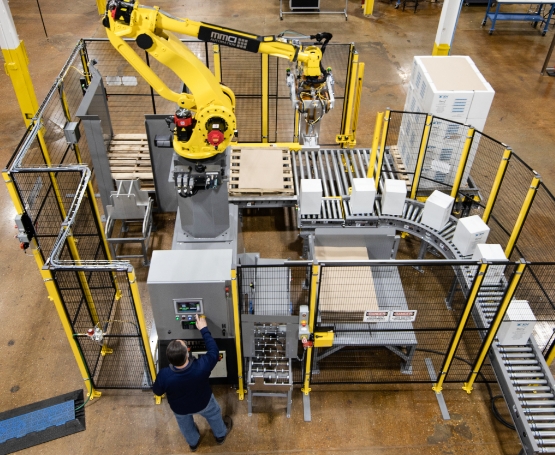
As robotics and automation became a driving force in Industry, 3 basic skills were prioritized and became known as the 3 P’s
PALLETIZING, PACKAGING, PART TRANSFER
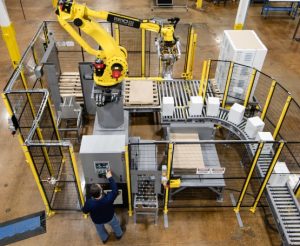
PALLETIZING
Palletizing involves using robots to efficiently stack or unstack items, like boxes or bags, onto pallets for shipping or storage. These robots are a cornerstone of modern logistics and warehousing, handling repetitive, heavy lifting tasks that can be tedious and physically demanding for human workers. By automating this process, companies can significantly increase speed and accuracy while reducing worker injuries. The system typically involves an infeed conveyor for products, an end-of-arm tool (EOAT) for grasping, a robotic arm for placement, and an outfeed conveyor for removed pallets.
PACKAGING
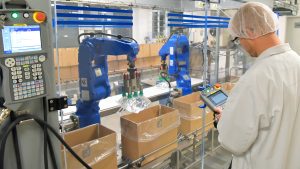
Packaging robots are used to place products into their final containers. This can include anything from placing food items into a box to sealing a pharmaceutical product. These robots are valued for their high speed and precision, ensuring consistent quality control. They can also perform other related tasks, such as labelling and sorting, as part of an integrated system. These systems use advanced machine vision, AI, and flexible robot types like articulated arms and cobots to handle a variety of products and adapt to different packaging needs, ultimately boosting throughput and reducing errors.
PART TRANSFER OR PICK & PLACE
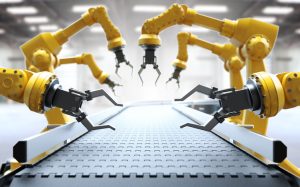
Part transfer, or “pick and place,” is the process of moving an item from one location to another. This is one of the most fundamental tasks in robotics, found across a wide range of industries. Robots perform this function with exceptional accuracy and speed, moving components between different stages of an assembly line or from a conveyor to a machine. This application is critical for automating assembly processes and ensuring a smooth, continuous workflow.
These robots automate repetitive, high-throughput tasks by employing sensors, actuators, and advanced control systems to identify, pick up, transport, and place items with speed and accuracy, increasing production efficiency while freeing human workers for more complex duties.
- Identification & Sensing: The robot’s vision system or other sensors locate the object to be picked up.
- Picking: A robotic arm with a specialized gripper, such as a vacuum nozzle or mechanical clamp, grasps the object.
- Transport: The arm moves the object to a predetermined location.
- Placing: The robot precisely places the object in its designated spot.
CONCLUSION
Unlike human labour, robotic arms can work continuously without fatigue, enhancing productivity and reliability. extreme environments, performing intricate procedures, and reducing risks to human workers. Robotics is the intersection of science, engineering and technology that produces machines, called robots, that replicate or substitute for human actions. Robots perform basic and repetitive tasks with greater efficiency and accuracy than humans, making them ideal for industries like manufacturing. This intersection is now integrated as the STEM Learning initiative firstly in the USA (coined in 2001 by Dr.Judith Ramaley, of the NSF). The primary purpose of STEM is to prepare students for a rapidly changing, technology-driven world by moving beyond rote memorization to active, hands-on, and real-world problem-solving.
- Mechanical construction: a frame, form or shape designed to achieve a particular task. For example, a robot designed to travel across heavy dirt or mud might use caterpillar tracks. …
- Electrical components that power and control the machinery. …
- Software.
- This means our present workforce needs to fully embody the integration of robotics into the workplace and accept that the skills required are shifting from simple, repetitive automation to advanced, AI-driven collaboration, creating a critical need for workers to acquire new technical skills. This transition is creating a “human-robot” partnership, where workers are transitioning into roles focused on programming, maintenance, and supervising automated system.
- High-Demand Technical Skills: There is a surge in demand for skills in robotics maintenance, mechatronics, and, increasingly, AI and data analytics to interpret machine-generated data.
- Robotics Integration: The workforce is learning to manage “cobots” (collaborative robots) and autonomous mobile robots, which requires skills in setting up, optimizing, and maintaining these systems.
Note: This post includes affiliate links for WPX Hosting, the service I use to keep this site fast and secure.
Do You Want To Put Your Own News on the Web

“My Secret Weapon for a Stress-Free Website.”
I trust and use WPX Hosting with this very website. They offer lightning-fast speeds, free site migrations, and a support team that responds in under 30 seconds. Click here to see why they’re consistently rated #1. WPX is famous for their free 24-hour site migrations, “they do all the heavy lifting to move your site”, WPX offers the Fastest Managed WordPress Hosting.