
MECHATRONICS this is one of the Absolutely Fundamental skills are required to pursue a career in Automation & Robotics, Mechatronics is a multidisciplinary field that combines mechanical engineering, electronics, computer engineering, telecommunications engineering, systems engineering, and control engineering. Its primary goal is the design, construction, and operation of smart products and processes. Where did this skill arrive from, Mechatronics was officially invented in 1969 when the term was coined by Tetsuro Mori, a senior engineer at the Japanese company Yaskawa Electric Corporation (now one of the big 4 Robotics Companies) Mori created the word by combining “mecha” from “mechanics” and “tronics” from “electronics” to describe the fusion of these two engineering disciplines.
The Evolution of Mechatronics
While the term itself is modern, the foundational concepts of mechatronics—integrating mechanical and electrical systems so forming mechatronics to be often described as the “soul” of modern engineering because it bridges the gap between mechanical hardware, electronic control, and the AI “brain.”— however it does have a longer history, its formal recognition and rapid development happened in distinct phases:
1970s: The Early Years
During this period, mechatronics primarily focused on the integration of basic electronic controls into mechanical systems. It was a new approach to product design that enhanced functionality and performance. Early applications included automatic door openers and autofocus cameras, where simple electronic circuits and sensors were used to control mechanical movements.
1980s: The Microprocessor Revolution
The advent of microprocessors and the boom in information technology were game-changers. By embedding microprocessors into mechanical systems, engineers could introduce more sophisticated control, feedback, and logic. This led to the development of “smarter” machines. A prime example is the anti-lock braking system (ABS) in cars, which uses sensors and a microprocessor to prevent wheel lock-up during braking, significantly improving safety.
1990s: The Integration of Software and Control
Mechatronics further expanded to include computer science and software engineering. This era saw the creation of complex, networked systems. Products became not just “smart” but also capable of real-time communication and complex decision-making. Technologies like airbags and advanced robotic systems became more widespread, showcasing the true synergy of mechanical, electronic, and software components.
Today, mechatronics is a fundamental field that underpins many modern technologies, from consumer electronics and medical devices to advanced robotics and industrial automation. It’s no longer just a combination of disciplines but a unified approach to designing intelligent, responsive systems.
I do get the feeling though that mechatronics is more developed in Europe (specifically Germany) were it feels like it is decades ahead of the UK, but this isn’t just about money—it’s about a fundamentally different philosophy toward manufacturing and education.
1. Why the EU (Germany) is More Advanced than the UK
In 2026, the gap between the EU and the UK in mechatronics is driven by three “pillars”: Investment, Integration, and Infrastructure.
A. The “Mittelstand” vs. The Service Economy
EU (Germany/Italy): Germany’s economy is built on the Mittelstand—thousands of small-to-medium specialized manufacturing firms. These companies must automate to survive high labor costs. This has created a massive internal market for mechatronics.
UK: The UK economy is heavily weighted toward Financial Services and software. Historically, the UK has preferred to hire flexible labor rather than invest in expensive, fixed-capital robotics. By 2026, the UK is playing “catch-up,” particularly in the automotive and compound semiconductor sectors.
B. The “Vocational” Prestige
EU: In Germany, becoming a “Mechatroniker” through a dual-education system (splitting time between a factory and a school) is a high-status, well-paid career path. It is seen as a “Professional” track, not a “Trade” track.
UK: There has traditionally been a cultural divide between “Academic” engineering (degrees) and “Vocational” training (apprenticeships). While the UK is fixing this with T-Levels and Degree Apprenticeships, the EU has a 50-year head start on this integrated model.
C. Robot Density (The 2026 Stats)
Europe has the highest level of industrial robot density worldwide.
Germany consistently ranks in the top 3 globally (alongside Japan and Korea).
The UK has historically lagged behind the global average, though 2026 is seeing a “post-Brexit” resurgence in local automation to solve labour shortages
AUTOMATION
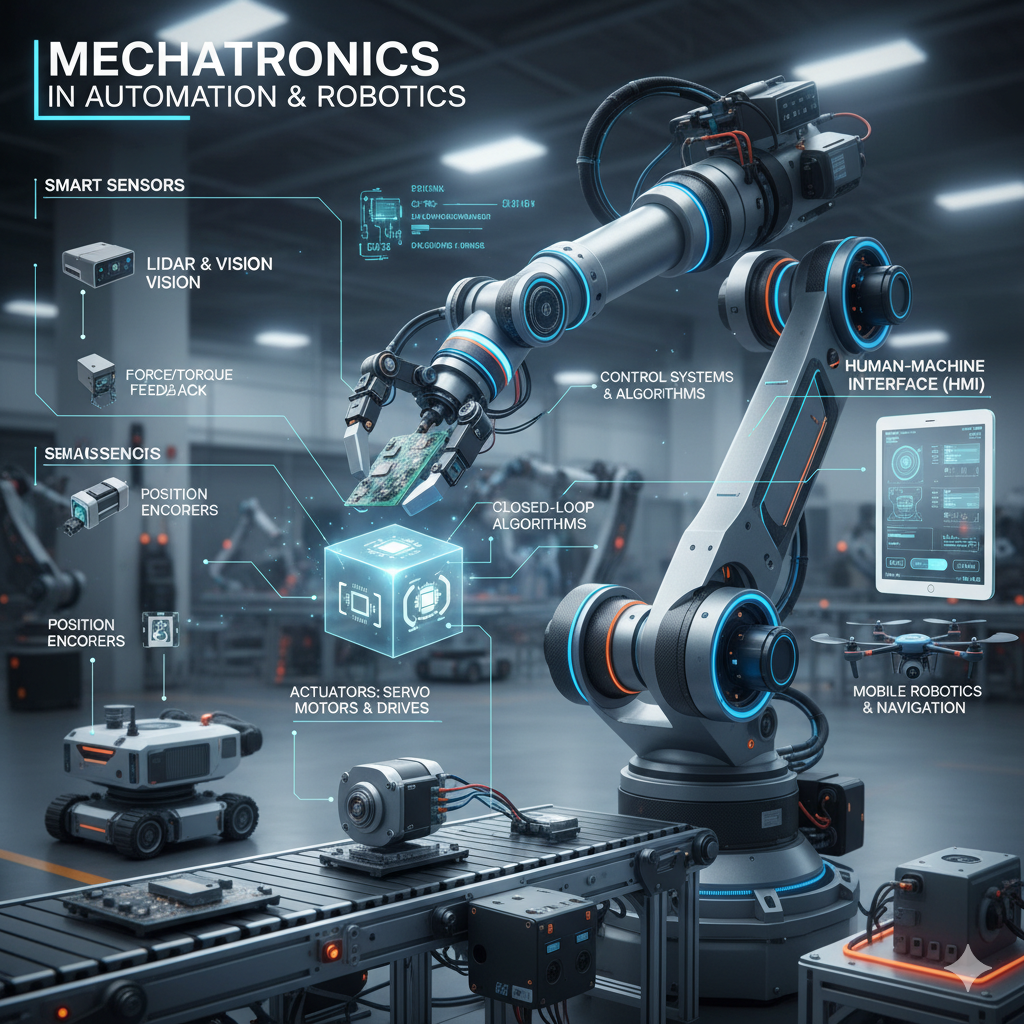
Automation involves using control systems and information technologies to reduce the need for human work in the production of goods and services. Mechatronics enables advanced automation through:
Smart Sensors and Actuators:
Sensors: Mechatronic systems integrate various sensors (e.g., proximity, temperature, vision, force) to gather data about the environment or the state of a process. This data is crucial for decision-making and feedback control.
Actuators: These are the components that perform the physical actions (e.g., motors, pneumatic cylinders, hydraulic systems). Mechatronics focuses on precise control of these actuators to achieve desired movements or operations.
Programmable Logic Controllers (PLCs) and Microcontrollers:
These electronic control systems are the “brains” of automated processes. They receive input from sensors, execute programmed logic, and send commands to actuators. Mechatronic engineers design the interfaces and programming for these controllers.
Feedback Control Systems:
A core concept in mechatronics is closed-loop control.11 Sensors provide feedback on the actual output, which is then compared to the desired output. The controller adjusts the actuators to minimize the error, ensuring accuracy and stability in automated tasks.
Human-Machine Interfaces (HMIs):
Mechatronics also encompasses the design of intuitive interfaces that allow operators to monitor and interact with automated systems, often through graphical displays and control panels.
Integration of Systems:
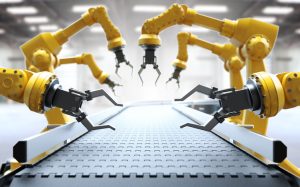
True automation often means integrating various mechanical components, electronic circuits, and software. Mechatronics provides the framework for seamlessly combining these elements into a cohesive, functional system, whether it’s an automated assembly line, a smart factory, or a packaging machine.
2. How to Gain Experience in Mechatronics
If you are transitioning from Pharma or another field, mechatronics requires a “T-shaped” skill set: deep expertise in one area (like Pharma compliance) and broad knowledge across the rest.
Phase 1: The “Digital Twin” Playground
In 2026, you don’t need a £100k lab to start. Use NVIDIA Isaac Sim or Gazebo (with ROS 2).
Action: Build a virtual pharmaceutical sorting arm. Program it to move vials without “spilling” (simulating fluid dynamics). This teaches you the software-to-hardware logic without the cost of breaking real motors.
Phase 2: Master the “Big Three” Skills
To be a mechatronics engineer, you need to speak three “languages”:
Mechanical: Understand Kinematics (how things move).
Electronic: Master PLCs (Programmable Logic Controllers). In Pharma, Siemens TIA Portal or Rockwell Automation are the gold standards.
Software: Learn Python for AI/logic and C++ for real-time motor control.
Phase 3: Industry-Aligned Certifications
| Focus | Certification | Why? |
| Industrial AI | NVIDIA Deep Learning Institute | Learn how to put “Computer Vision” on a robotic arm. |
| Core Mechatronics | Siemens Mechatronic Systems Certification (SMSCP) | This is the global gold standard for system-level thinking. |
| Control Systems | ROS 2 (Robot Operating System) | Essential for modern, flexible robotics used in R&D labs. |
3. The “Pharma Edge” Strategy
For anyone who has pharmaceutical experience, your fastest path to mechatronics is Lab Automation.
The Bridge: High-throughput screening (HTS) and automated compounding are purely mechatronic systems. Look for roles at companies like Tecan, Hamilton, or Recursion Pharmaceuticals. They value people who understand Sterile Constraints and FDA Validation (hardware + software compliance).