

THE ROBOTICS ENGINEER – WHO ARE THEY ?
Robotics is at the intersection of AI, mechanical engineering, and computer science, making it one of the most dynamic career paths in 2026, As industries move from simple automation to “intelligent” machines, there is a massive appetite for clear information on how to break into the field. Becoming a robotics engineer in 2026 is a blend of traditional engineering principles and high-fidelity digital simulation. Unlike standard software roles, you are responsible for the “Sim-to-Real” pipeline—ensuring that what works on a screen actually works on the shop floor
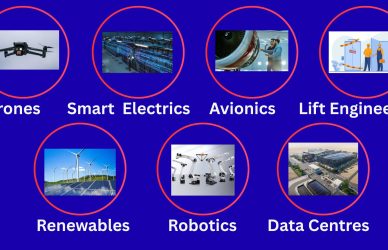
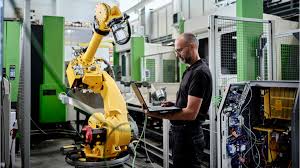
Here is a breakdown of the key pillars that are relevant to todays Robotics Engineer or to anyone seeking guidance on how to achieve this status .As the image above shows and perhaps confuses us, is Robotics Engineering aa desk job with PC’s, a workshop diagnostics job or working on production lines monitoring the Robots. Well it is in fact a mixture of all 3 with probably some other roles chucked in for good luck.
1. The Role: What They Actually Do
A Robotics Engineer doesn’t just “build robots.” The role is highly multidisciplinary which explains why they sit at the centre of three main domains:
Mechanical Engineering: Designing the “body” (frames, joints, and grippers).
Electrical Engineering: Designing the “nervous system” (sensors, power systems, and circuitry).
Computer Science: Programming the “brain” (AI, computer vision, and path planning).
2. Education & Skillset
The barrier to entry is high, but the path is well-defined. Most professionals follow this trajectory:
Degrees: A Bachelor’s in Mechanical, Electrical, or Mechatronics Engineering is standard. A Master’s or PhD is increasingly common for roles involving Machine Learning or Kinematics
The Degree (The Foundation)
Best Majors: Mechatronics, Mechanical Engineering, Electrical Engineering, or Computer Science.
The Advantage: It teaches the “why.” You’ll need the linear algebra, physics (kinematics/dynamics), and control theory that certifications often skim over.
2026 Trend: Many universities now offer Robotics Minors or specialization tracks in Physical AI, which are highly valued by employers like Tesla, Boston Dynamics, and Amazon Robotics.
Key Software: Mastery of ROS 2 (Robot Operating System), C++, and Python is non-negotiable.
Hardware Knowledge: Familiarity with CAD (SolidWorks/AutoCAD) and PCB design.
Hands-on Certifications (The Skills).
Certifications are your “proof of work.” In 2026, employers look for specific tool mastery rather than just general knowledge
| Certification Type | Examples | Best For… |
| Industry Standard | FANUC Certified Robot Operator, NC3 | Industrial manufacturing and traditional arms. |
| Software/AI | NVIDIA Isaac Sim Courses, Udacity Robotics Software Engineer | AI-driven robotics and high-fidelity simulation. |
| Open Source | ROS 2 (Robot Operating System) Certification | Startups and R&D where flexibility is key. |
| Cloud/DevOps | AWS Certified Robotics, Microsoft Azure AI Engineer | Managing large robot fleets in the cloud. |
3. The “New” Training Landscape
Traditional degrees are no longer the only way, the “barrier to entry” is shifting. While a degree provides the theory, certifications are becoming the preferred way to prove you can handle modern tools like ROS 2 or NVIDIA Isaac.
Simulators: Tools like Gazebo or NVIDIA Isaac Sim allow engineers to train robots in virtual environments before touching hardware.
Micro-credentials: Specialized certifications in PLC programming or industrial cobots (Collaborative Robots).
4. Career Prospects & Specializations
The job market is expanding beyond automotive manufacturing and figures intensely in these booming sectors:
AgTech: Autonomous tractors and fruit-picking drones.
Medical: Surgical robots and exoskeleton rehabilitation.
Logistics: Warehouse AMRs (Autonomous Mobile Robots) like those used by Amazon.
A Day in the Life of a Robotics Engineer
A robotics engineer’s day is rarely just “building robots.” It is an iterative loop of designing, virtual testing, and physical troubleshooting.
Morning: Designing & Brainstorming
09:00 AM: Reviewing sensor data from overnight tests.
10:30 AM: CAD Modelling. Using tools like SolidWorks or Fusion 360 to design a new gripper or sensor mount. You aren’t just looking at aesthetics; you’re checking for “collision zones” and weight distribution.
Midday: Simulation-First Development (Isaac Sim)
01:00 PM: NVIDIA Isaac Sim. Instead of risking a £50,000 prototype, you import your CAD model into Isaac Sim.
Why Isaac Sim? In 2026, we use it for Synthetic Data Generation (SDG). You create thousands of virtual scenarios—different lighting, obstacles, and floor textures—to train the robot’s “brain” (computer vision) before it ever sees a real room.
- Digital Twin Testing: You run a “Software-in-the-Loop” (SIL) test to see how your code handles a motor failure in the virtual world.
Afternoon: Hardware Testing & “Sim-to-Real”
03:30 PM: The Lab. You push your code to the physical hardware. This is the “Sim-to-Real” gap. Often, the robot behaves differently in person due to friction, gravity, or sensor noise that simulation didn’t perfectly capture.
- 04:30 PM: Hardware Debugging. Tightening bolts, recalibrating LiDAR sensors, or soldering a loose connection. You might spend an hour figuring out why a 1% difference in floor friction is causing the robot to slip.
| Feature | Degree Path | Certification/Skills Path |
| Focus | Theory, Math, Systems Architecture | Tool Mastery, Coding, Troubleshooting |
| Timeline | 4+ Years | 3–9 Months |
| Top Tool | MATLAB/Simulink | ROS 2 / NVIDIA Isaac Sim |
CAREER TIP
Python’s Role in Robotics Engineering
Apprentices and Students have sometimes asked me ” how do I get on to the next level in the Robotics Engineering World ? ” My reply is to study the “Brains behind the Operation ” those BRAINS at the moment (2026) belong to Python who has become the “glue” that holds modern robotics together. While lower-level languages like C++ are used for the robot’s physical movements (where speed is everything), Python is used for the “thinking.” Here is why it’s a non-negotiable skill for a Robotics Engineer,
1. The Language of AI and Machine Learning
Robots are no longer just following pre-programmed paths; they are learning to see and adapt. Python is the native language for nearly every major AI framework, such as PyTorch and TensorFlow. If you want a robot to recognize an object or navigate a room, you’ll likely be writing that logic in Python.
2. Integration with ROS 2
The Robot Operating System (ROS 2) is the industry-standard middleware. While it supports several languages, Python is the primary choice for writing “nodes”—the small programs that handle high-level tasks like sensor data processing or mission planning. It allows engineers to quickly script how different parts of the robot talk to one another.
3. Rapid Prototyping
In robotics, you often need to test an idea quickly. Python’s syntax is clean and readable, meaning you can write and test a script in minutes that might take hours to compile in C++. This speed is vital when you are calibrating sensors or testing a new navigation algorithm.
4. Massive Library Ecosystem
Robotics involves a lot of complex math, from linear algebra to computer vision. Python provides instant access to powerful libraries that do the heavy lifting for you:
NumPy: For complex matrix calculations ($Ax = b$).
OpenCV: For real-time computer vision and image processing.
SciPy: For optimization and signal processing.
Pharmaceutical Industry Trends and Stars of the Future.
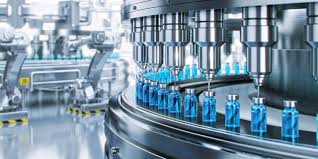
From my experience in the Pharmaceutical Industry it is not so much “dirty, dull, and dangerous” (but in pharma’s case, the “precise, sterile, and repetitive”) tasks that robots are perfect for. In 2026, the intersection of Pharma + Robotics is moving beyond simple liquid handling into Autonomous Science, where robots don’t just move vials—they design the experiments. One must remember that in the Pharma World – Compliance is King: Unlike a warehouse robot, a Pharma robot (like those from Meilan Pharmaceutical) must meet strict FDA/CGMP standards.
1. Pharmaceutical & Lab Automation
These Companies are moving from “robotic arms” to “robotic scientists.” In the “VLA” Shift: In 2026, we are seeing Vision-Language-Action (VLA) models. This means a lab tech can tell a robot: “Purify this sample and alert me if the pH shifts,” and the robot understands the context without complex coding.
Recursion Pharmaceuticals: A leader in “Tech-First” drug discovery. They use massive automated wet labs to run millions of experiments weekly, feeding the data into AI models to find new treatments
Exscientia: Based in the UK, they were among the first to bring AI-designed drugs to clinical trials. They focus on highly automated chemistry and “precision design” platforms.
- C12.ai: A rising star in 2026. Their flagship robot, Talos, is a mobile “AI Scientist” that can navigate a lab, perform molecule purification, and achieve a 93% success rate compared to human chemists
- Persist AI: They use high-throughput robotics specifically for drug formulation. They can predict and build thousands of different drug delivery versions in parallel, which is traditionally a massive bottleneck
- Insilico Medicine: They use a unified platform called Pharma.AI to link robotic biological testing with generative chemistry, drastically shortening the time from “idea” to “clinical trial.”
2. Hidden Gems: In the wider sphere – Agriculture & Space
On the more ” rugged “side of the coin I would like to highlight these Niches that are booming in 2026.
Agriculture: From “Hype” to “ROI”
GrazeMate: This startup builds autonomous drones for cattle herding. Instead of helicopters, ranchers use AI drones that position themselves to guide herds while simultaneously scanning for sick animals or measuring grass biomass.
Red Barn Robotics: They’ve developed the “Field Hand,” a robot that uses precision lasers or mechanical tools to kill weeds individually, reducing the need for the massive chemical spraying common in the pastLazare Farms: A leader in Autonomous Vertical Farming. Their “Lazare OS” manages every drop of water and photon of light, allowing exotic crops to be grown in any climate with zero pesticides.
Space: Extreme Environment Engineering
Honeybee Robotics (Blue Origin): The gold standard for space. They build the drills and sampling systems used on Mars. Working here means designing for vacuum, radiation, and extreme temperature swings
General Astronautics: A 2026 “hidden gem” focusing on robots specifically designed for microgravity manufacturing. They are exploring how to make better fiber optics or medicines in space where gravity doesn’t interfere with molecular structures.
Reflect Orbital: A fascinating “Space-to-Earth” startup that uses orbiting reflectors to direct sunlight to solar farms at night. They require robotics experts to handle the precision orientation of these massive space mirrors.
In 2026, the robotics industry has split into three distinct “hiring lanes”: the Legacy Giants (stable, industrial), the Humanoid/AI Disruptors (high-growth, risky), and the Vertical Specialists (niche solvers).
Here are the top companies to watch out for and categorized by their role in the ecosystem.
1. The Humanoid & “Physical AI” Disruptors
These are the trendiest companies in 2026. They are moving away from “pre-programmed” robots toward General Purpose Robotics that learn via simulation
Tesla (Optimus): With the Gen 3 Optimus pilot programs running in Tesla factories this year, they are the biggest hirer for “Sim-to-Real” engineers.
Figure AI: Backed by Nvidia and OpenAI, Figure is scaling humanoid deployments in automotive manufacturing (notably BMW).
Agility Robotics: Their robot, Digit, is the first to be commercially deployed at scale in Amazon warehouses. They look for experts in legged locomotion
- 1X Technologies: Supported by OpenAI, they focus on “safe” humanoids (NEO) for both home and industrial assistance
- Physical Intelligence ($\pi$): A “stealth-to-scale” leader in 2026, focusing on a universal foundation model for any robot hardware.
2. The Infrastructure “Kingmakers”
You don’t always have to build the robot; you can build the brain or the tools they run on.
NVIDIA: The most critical employer for robotics engineers today. Their Jetson hardware and Isaac Sim software are the industry standards for simulation and Edge AI.
Anduril Industries: A powerhouse in defence robotics. They hire heavily for autonomous drones, underwater vehicles, and AI-driven border security.
- Intutive Surgical: The undisputed leader in medical robotics. Their da Vinci systems are the gold standard for robotic-assisted surgery.
3. Industrial & Logistics Titans
If you want to work on robots that are already moving millions of tons of cargo or assembling cars, these are the incumbents.
Amazon Robotics: Still the world’s largest operator of mobile robots. They are a massive hirer for fleet management and computer vision.
ABB & FANUC: The “Big Two” of industrial arms. If you are interested in the precision engineering of the arms used by Apple or Toyota, these are your targets.
- Boston Dynamics: Now owned by Hyundai, they’ve transitioned from “cool YouTube videos” to practical industrial solutions with Spot (inspection) and Stretch (truck unloading).
SUMMARY
| Company Type | Key Tools Used | Best For… |
| Tesla / Figure | PyTorch, Isaac Sim, CUDA | Engineers who want to build the “Future of Labour.” |
| NVIDIA | C++, Omniverse, Python | Engineers who want to build the tools everyone else uses. |
| Intuitive Surgical | Real-time OS, Haptics | Engineers interested in high-stakes, life-saving precision. |
| Anduril | Computer Vision, Sensor Fusion | Engineers interested in defence and high-autonomy drones. |
Pro-Tip : In 2026, many of these companies (like Standard Bots or Formic) are moving toward Robotics-as-a-Service (RaaS). Instead of selling a robot for £100k, they “rent” the robot’s labour to small factories. This is creating a huge demand for Field Robotics Engineers who can deploy and maintain these fleets.
Lorem ipsum dolor sit amet, consectetur adipiscing elit. Ut elit tellus, luctus nec ullamcorper mattis, pulvinar dapibus leo.