
The Swedish Engine: Powering Europe’s Industrial Automation Revolution.
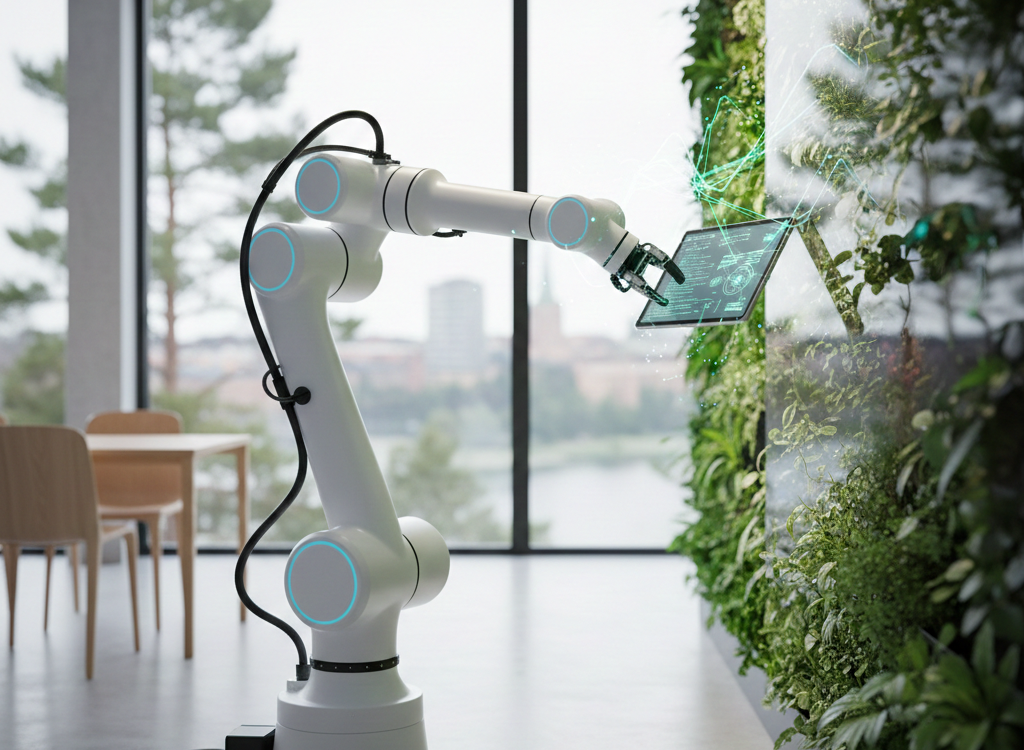

The Swedish Secret
“Sweden has long been known for its minimalist design and breathtaking landscapes, but beneath the surface of this Nordic powerhouse, a quiet revolution is unfolding. It’s not just about building machines; it’s about redefining the relationship between technology and the planet. While the rest of the world races for speed, Swedish innovators are asking a different question: How can we make robotics smarter, greener, and entirely autonomous? From the bustling tech hubs of Stockholm to the automated forests of the north, the future of the industry isn’t just being built—it’s being written in Swedish code.”
“I may earn a commission if you sign up through my link at no extra cost to you”
Sweden’s influence in robotics and automation is a classic case of a country “punching above its weight.” Despite its relatively small population, Sweden has established itself as a global nerve centre for industrial intelligence, balancing a legacy of heavy-industry engineering with a modern, high-speed AI ecosystem.
Sweden is home to some of the world’s most dominant industrial players. When you speak about automation globally, you cannot omit the “Big Four” of robotics, which includes ABB.
Sweden consistently ranks as one of the most Automated nations on Earth.
-
Robot Density: Sweden ranks among the top 5–10 globally for robot density (the number of robots per 10,000 employees), with roughly 321 robots per 10,000 manufacturing workers.
-
Regional Dominance: Within the Nordic region, Sweden holds a staggering 41% market share of the IT and automation sector.
| Company | Core Strength | Global Impact |
| ABB | Industrial & Cobots | Supplies 95% of the European market from Sweden. |
| Hexagon | Sensors & Humanoids | Provides the “intelligence” and sensing for global industry. |
| Atlas Copco | Smart Assembly | Defines the data-driven standards for modern factories. |
| Einride | Autonomous Logistics | Pioneering the transition to driverless, electric freight. |
| Cognibotics | Precision Motion | Revolutionizing robot speed and accuracy via R&D. |
-
ABB Robotics: Headquartered in Västerås, ABB is the backbone of European robotics. In late 2023, they announced a $280 million investment to build a new 65,000 $m^2$ “Robotics Campus” in Sweden, set to open in 2026. This isn’t just a factory; it’s an AI-enabled R&D hub that will supply roughly 95% of their European market.
-
Hexagon AB: While often categorized as a “sensor” company, Hexagon is the world leader in autonomous reality capture. Their technology provides the “eyes” and “ears” for industrial robots, making them essential for the digital twins used in smart factories globally.
-
Atlas Copco (The Smart Factory Architect)
While known for compressors and tools, Atlas Copco has quietly become a leader in integrated assembly automation.
-
Why they matter: They represent the shift from “stand-alone robots” to “connected ecosystems.” Their systems use machine vision and data-driven software to automate complex tightening and gluing tasks in the automotive and aerospace industries.
-
The “Smart” Factor: Their 2025 focus is on “The Smart Factory of Tomorrow,” where every automated tool on a line communicates to prevent defects before they happen.
-
- Einride (The Autonomous Disrupter)
Einride is the “Tesla of Freight.” They don’t just build trucks; they build an entire autonomous freight operating system.
-
Why they matter: They were the first in the world to operate a cab-less (no driver seat) electric truck on a public road.
-
2025 Milestone: In late 2025, Einride achieved a world-first by completing an autonomous, cab-less cross-border delivery between Norway and Sweden, proving that autonomous logistics can handle complex international customs and regulations.
-
Cognibotics (The Precision Specialists)
-
A spin-off from Lund University, Cognibotics is the “brainy” challenger in the field, specializing in high-speed, lightweight robot arms.
-
Why they matter: Traditional robots are heavy and lose precision at high speeds. Cognibotics uses advanced mathematical models and “long-reach” mechanics to create robots that are faster and more accurate than industry standards.
-
The Niche: They are the go-to for companies needing extreme precision in small spaces, often outperforming the larger giants in specialized manufacturing tasks.
-
-
Ericsson: Their leadership in 5G and private networks is the “glue” for Industry 4.0. Without their low-latency connectivity, mobile robots (AMRs) and cloud-based automation wouldn’t function at scale.
Sweden’s influence is built on a “quadruple helix” model—a tight integration of government, academia, industry, and a thriving start-up scene.
The reason Sweden stays relevant is its collaborative ecosystem, often called the “Quadruple Helix”: the synergy between University research, Government support (via agencies like Vinnova), and Private Industry.
AI Sweden: The national centre for applied AI ensures that robotics companies aren’t just building “dumb” arms, but intelligent systems capable of edge learning.
-
Sustainability as a USP: Sweden has branded itself as the leader in “Green Automation.” The focus isn’t just on efficiency, but on using robotics to reduce carbon footprints and enable circular manufacturing, Sweden isn’t just adopting robotics; it’s refining them to be the most sustainable and intelligent in the world.
- Sweden has moved beyond selling hardware, they are now the global architects of the software-defined factory, where AI and connectivity are more valuable than the steel of the robot itself


ABB Technical training for Robotics Engineers ABB Robots on parade ready for the production line.
ABB to open Integrated Robotics Campus in Sweden in 2026
The ABB Robotics European Campus in Västerås is currently the most significant industrial project in Sweden. As of late 2025, the project has moved from the drawing board to a massive active construction site in the Finnslätten industrial area.
The “Västerås Mega-Campus”: By the Numbers
The Investment: A massive $280 million (approx. 3.1 billion SEK).
Size: 70,000 $m^2$—effectively consolidating nine separate, older buildings into one state-of-the-art “super-hub.”
Timeline: Ground was officially broken in June 2025. While initial reports targeted a 2026 opening, the latest updates suggest a phased rollout with full completion aimed for late 2026 into 2027.
Capacity Boost: It will increase ABB’s European manufacturing capacity by 50%.
Why It’s a “Game Changer” for Europe
This campus is the final piece of ABB’s “local-for-local” strategy. They now have “Mega Factories” in Shanghai (serving Asia), Auburn Hills (serving the Americas), and now Västerås (serving Europe).
1. The AI Factory
This isn’t just a place where robots are built; it’s a place where they are “taught.” The campus features a dedicated AI-enabled R&D centre where engineers are developing the next generation of collaborative robots (cobots).
2. Living Lab & Training Centre
One of the most unique aspects is the “Experience Centre.” It is designed so that customers—from small bakeries to massive car manufacturers—can bring their specific production problems to the campus and “test-drive” automation solutions before buying them.
3. Sustainability as a Blueprint
ABB is using this campus to prove that heavy industry can be green.
Energy Efficiency: The facility is designed to use 50% less energy than the buildings it replaces.
Renewable Power: The roof is a sea of solar panels, and the building uses geothermal heating/cooling and “energy wells” to maintain its climate.
Material Flow: Inside the factory, material transport is handled entirely by Autonomous Mobile Robots (AMRs), creating a silent, driverless internal logistics chain.
The futuristic new ABB Campus buildings ( as seen above) which are an “Innovation Ecosystem,” Not Just a Factory and hopefully will secure Sweden’s Future as Europe’s Robotics Capital. The ABB CEO Björn Rosengren was very bullish about the campus as a strategic move to secure ABB’s dominance in the European market following similar large-scale investments in China and the U.S.
On market growth Rosengren stated “The investment in our new Campus is driven by customer demand and projected market growth. Following important investments in China and the U.S., the new facility in Sweden will strengthen our capabilities in serving our customers in Europe with locally manufactured products in a growing market,” and regarding the Local -for-Local strategy Rosengren added “Already today, around 95 percent of the robots ABB sells in the region are manufactured here [in Västerås]. This is a strong commitment not only to our ‘local for local’ strategy, but to all our robotics customers across Europe.”
Marc Segura, President of ABB Robotics emphasized the technological and historical significance of the site, positioning it as the “brain” of their global R&D efforts, as regards innovation and AI “In our new R&D centre we are focusing on the development of new digital and AI-enabled technologies, making robots increasingly accessible while lowering the entry barrier for applications in all industries.” With regards to the site “Our new, sustainable facility in Sweden will be located at the cradle of ABB Robotics’ global innovation, starting with ABB’s development of the world’s first commercial all-electric robot nearly 50 years ago.”
“By delivering flexible, modular, AI-powered technology we aim to lower barriers to automation, thus we are driving adoption of advanced manufacturing in new segments and supporting the next wave of industrial innovation.” so ABB with this massive project for them—essentially turning Västerås into the “Silicon Valley” of European robotics.


The ABB-SKF Strategic Alliance
ABB are one of the 4 Powerhouses of the Robotics world, a major recent development in European industry is the deepened partnership between these two Swedish titans. In late 2022, they signed a Memorandum of Understanding (MoU) that has reached full maturity in 2024–2025
-
The Goal: Combining ABB’s robotics with SKF’s “rotating shaft” expertise to create fully autonomous production cells.
-
Impact: This collaboration is being used as a blueprint for “Green Automation”—using AI to reduce CO2 emissions and energy consumption in heavy manufacturing across the EU.
SKF: The Silent Engine of Automation 
While ABB makes the “arms,” SKF (Svenska Kullagerfabriken) makes the movement possible. SKF is no longer just a “ball bearing company”; it has evolved into a high-tech motion engineering partner that is critical to European automation.
Key Contributions to Robotics:
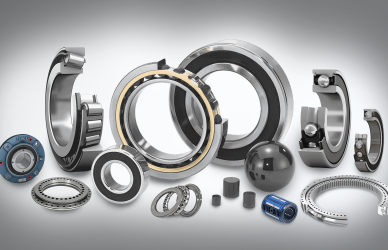
Precision and Weight: SKF’s thin-section bearings (like the Kaydon Reali-Slim line) are essential for modern robotic joints They allow robots to be lighter and more compact while maintaining high payload capacities—critical for the “cobot” (collaborative robot) market.
The “RoboFMS” Initiative: SKF has transformed its own manufacturing into a global benchmark. Their Robotic Flexible Manufacturing System (RoboFMS) allows their European factories (like those in France and Sweden) to produce complex components autonomously for long periods with near-zero setup time.
Smart Bearings (Industry 4.0): SKF integrates sensors directly into bearings to monitor vibration, temperature, and speed in real-time. In an automated European factory, these bearings “talk” to the central AI to predict maintenance needs before a robot breaks down.

Kaydon Reali- Slim thin section ball bearings enable high payloads and space savings for robotics applications across a range of industries.
If SKF is the “joints” of Swedish automation, Piab is the “hands.”
Headquartered in Täby, Sweden, Piab is arguably the global leader in vacuum-based gripping technology, and their influence on European automation—especially in logistics, packaging, and food is massive. In 2024–2025, Piab has shifted from being a component supplier to a full-stack “moving and gripping” powerhouse- EOTA ( End of Arm Tooling).
1. The Secret Sauce: COAX® Technology
The heart of Piab’s dominance is their patented COAX® technology. Unlike traditional vacuum pumps that use loud, energy-hungry electric motors, COAX® uses compressed air to create a vacuum.
Efficiency: It is up to 50% more energy-efficient than conventional ejectors.
-
Decentralization: Because the vacuum “cartridges” are so small, they can be placed directly on the robot’s arm (at the point of suction). This eliminates the need for long, leaky vacuum hoses, leading to faster “pick and place” cycles.
-
Reliability: With no moving parts, these generators can run for millions of cycles in harsh, dusty environments (like flour mills or cement plants) where mechanical pumps would fail.
2. The “Cobot” Revolution: piCOBOT®
Piab has become the “go-to” partner for the world’s leading collaborative robot (cobot) brands. Throughout 2024 and 2025, they have expanded their piCOBOT® line to provide “Plug-and-Play” solutions for:
-
Universal Robots (UR): Certified through the UR+ ecosystem.
-
FANUC & ABB: Recently released dedicated versions for the FANUC CRX and ABB GoFa series.
-
Impact: This allows a small European bakery or a pharmaceutical lab to automate their packing line in hours rather than weeks, as the vacuum generator and gripper are pre-configured to “talk” to the robot’s software.
3. Expansion through Strategic Acquisitions
Piab’s influence in Europe has grown through a series of smart acquisitions that have broadened their “grip” on the market:
-
Kenos®: A brand they acquired that specializes in large-area vacuum grippers (heavy-duty pads that can pick up an entire layer of jars or heavy wooden planks).
-
Alum-a-Lift (2024): A major recent acquisition that moves Piab into the semiconductor and aerospace lifting sectors, further diversifying their European industrial footprint.
-
Sustainability Push: In 2025, they are leading the market in PFAS-free suction cups and materials, catering to the strict new environmental regulations across the EU.
Summary of Sweden’s “Robotic Trifecta”
When you look at Swedish industry, you see a complete ecosystem:
-
ABB provides the Brain (Controllers) and Body (Arms).
-
SKF provides the Skeleton (Bearings) and Nerves (Sensors).
-
Piab provides the Touch (Vacuum Grippers).
-
Together, these three companies allow Sweden to export entire automated “solutions” rather than just parts.
Conclusion: Why Sweden is the One to Watch 
“As we look toward the 2030s, the global robotics race is no longer just about who can build the fastest machine, but who can build the wisest one. Sweden’s unique ‘Quadruple Helix’ model—a seamless collaboration between government, academia, private industry and active start-up community—has created a fertile ground where ethics and efficiency coexist.
By prioritizing sustainability and human-centric design, Sweden is proving that high-tech doesn’t have to mean high-impact on the environment. Whether it’s a social robot assisting in a Stockholm hospital or an autonomous harvester protecting northern forests, the Swedish approach is clear: technology should serve the planet as much as it serves the person. The future of robotics isn’t just a vision anymore; it’s a reality being coded, tested, and deployed right now in the heart of Scandinavia.”
So how friendly is Sweden for British Workers ?
It is possible for British blue-collar (skilled ) workers and freelancers to work in Sweden, but since Brexit, the process has become significantly more rigorous. You are now treated as “third-country nationals,” meaning you need specific permits before you arrive. The rules are tightening further in June 2026, making it even more challenging for lower-wage or entry-level roles.
HOWEVER Robotics and Automation Engineers/Technicians are currently on Sweden’s shortage list (2026). This means:
-
Salary Flexibility: While the new June 2026 salary floor is SEK 33,390, roles on the shortage list can sometimes bypass the strict “90% of median” rule if the union agrees the pay is fair for the sector. (Though in Robotics, your pay will likely be much higher anyway).
-
Fast-Tracking: Many automation firms (like ABB, Northvolt, or Scania) have “certified” status with the Migration Agency, meaning they can get a work permit approved in weeks rather than months.
-
High-Demand Trades (The “Shortage List”)
If you work in a trade that is in high demand, some salary requirements may be relaxed or permits fast-tracked. Current shortages include:
Electricians and Plumbers
Heavy-vehicle mechanics
Construction engineers and site managers
HVAC technicians
Challenges for Freelancers (Self-Employed)
If you plan to freelance (contracting) rather than taking a staff job, Sweden is surprisingly tough. They don’t have a “Digital Nomad” visa.
-
The 2-Year Savings Rule: You must prove you can support yourself for two years without earning a penny. For a single person in 2026, this requires roughly SEK 200,000 (~£15,000) in a bank account.
-
The “Established Network” Requirement: You cannot just say “I am a good robotics blogger/engineer.” You must show signed contracts or letters of intent from Swedish clients. They want to see that your business is already “plugged in” to the Swedish economy.
- The Job Seeker Visa Alternative: If you have a degree, you can apply for a Job Seeker Visa (3-9 months). This allows you to move to Sweden to look for work or set up a business before you have the permit, but you cannot actually start working until the permit is granted.
The Language Barrier in Industrial Sites
While the “tech” side is English-speaking, the “blue-collar” side (maintenance, floor technicians) often speaks Swedish. If you are a freelancer trying to integrate a robot on a factory floor in Västerås, not knowing Swedish technical terms can lead to “siloing,” where you are left out of the crucial informal safety chats.
Tax & “F-skatt”
To freelance, you need F-skatt (F-tax) status. Swedish companies are terrified of “hidden employment” (where a freelancer is treated like an employee). They may refuse to hire you as a freelancer unless you have a Swedish limited company (Aktiebolag or AB), which requires SEK 25,000 in starting capital.
The “Personnummer” Catch-22
To do almost anything in Sweden—open a bank account, get a phone contract, or even join a gym—you need a Personnummer (personal ID number).
-
The Problem: You can’t get one until you have a residence permit and a registered address.
The Result: Your first few months can feel like “digital exile” where you struggle to access basic services.
“I may earn a commission if you sign up through my link at no extra cost to you”

A very good solution to your initial problem could be WISE, “The first thing you’ll need is a way to pay for coffee and rent without getting hammered by conversion fees. I personally use and recommend Wise—it’s the easiest way to hold Krone’s Euros, Pounds, and 40+ other currencies in one place.” WISE is a Global Technology Company that’s building the BEST WAY to transfer money around the WORLD. OPEN YOUR NEW ACCOUNT WITH WISE, get your card sent straight away.