

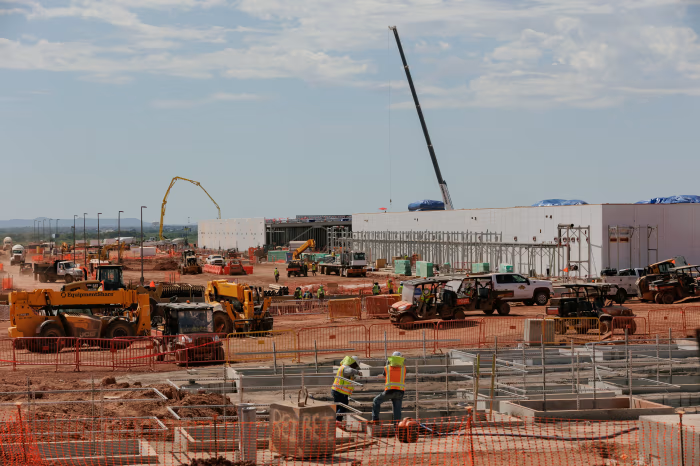

An investment boom in artificial intelligence is creating a thirst for massive data centres, ( photo courtesy of – shelby tauber/Reuters).
The AI Data Centre Boom: A Gold Rush for Skilled Workers
The world’s growing hunger for Artificial Intelligence (AI) is fuelling a massive construction boom: the building of next-generation data centres. These aren’t your typical server farms; they are hyper-dense, power-hungry, and technologically complex facilities specifically designed to train and run the enormous, sophisticated AI models that are reshaping our lives.
This unprecedented build-out is not just an infrastructure story—it’s a workforce revolution. The race to build the backbone of AI is creating a soaring demand for specialized, skilled workers across multiple disciplines, from blue-collar trades to cutting-edge technology experts.
The Infrastructure Challenge: A Need for Specialized Trades
The construction phase of these AI data centres alone is driving an immense need for skilled tradespeople, often leading to significant wage increases and competition for talent. The scale and technical complexity of these projects mean that traditional skills must be paired with modern, data-centre-specific knowledge.
Top Demands in Construction and Facility Operations:
Electricians & Electrical Engineers: AI data centres consume massive amounts of power—up to 140 kilowatts per rack, compared to 2–4 kilowatts for legacy racks. This requires expertise in high-voltage power distribution, redundant systems, and complex electrical configurations.
HVAC & Mechanical Specialists: AI hardware (like GPUs and TPUs) generates intense heat. Professionals skilled in advanced cooling systems, such as liquid and immersion cooling, are essential for maintaining optimal performance and efficiency.
Construction Managers: Given the accelerated timelines and coordination required for these multi-million-square-foot, intricate projects, skilled managers are needed to coordinate complex trades and logistics.
Data Centre Technicians & Facility Engineers: Once built, these facilities require technicians for 24/7 monitoring, maintenance, and repair of critical systems (electrical, mechanical, and HVAC).
The Operational Shift: AI Integration Redefines Roles
The finished data centres are themselves powered by AI for optimal efficiency. This integration isn’t replacing human staff, but rather redefining their roles, shifting the focus from routine tasks to strategic oversight and high-value problem-solving, AI helps by automating tasks like:
Predictive maintenance for cooling and power units.
Real-time monitoring of temperature, humidity, and power.
Optimizing workload distribution and energy usage.
As a result, the essential data centre workforce must now possess a blend of traditional infrastructure expertise and new competencies:

Role Key AI-Driven Responsibilities Data Centre Engineers Implementing and managing AI-driven systems for dynamic power optimization, intelligent cooling, and anomaly detection. Security Analysts Utilizing machine learning for advanced threat detection and anomaly monitoring to safeguard against increasingly sophisticated cyberattacks. Facility Managers Interpreting vast amounts of data and AI-generated insights to make strategic decisions on operational efficiency, resource management, and capacity planning. Network Specialists Managing the high-speed, high-bandwidth networks required for AI workloads, often incorporating software-defined networking and automation
The Brains of the Operation: The Core AI Workforce
Beyond the physical infrastructure, the very purpose of these data centres—to develop and run AI—demands a specialized technical workforce. These roles are critical for designing the models, managing the data, and building the applications.
Data Scientists: The investigators who collect, analyse and interpret massive datasets to train the AI models, requiring strong statistical and programming (Python/R) skills.
AI/Machine Learning Engineers: The architects who design, implement, and maintain the AI infrastructure and algorithms, transforming theoretical models into scalable, practical applications.
Data Engineers: Professionals who build and maintain the robust data pipelines that ensure raw data is collected, managed, and converted into usable information for the AI models.
The New Hybrid Skill Set
The most valuable professionals in this AI era are those who bridge the gap between disciplines. A facility engineer who understands networking, or a data scientist with an appreciation for the physical constraints of cooling a server rack, holds a distinct advantage.
Furthermore, non-technical skills are becoming paramount:
Problem-solving and Critical Thinking to manage complex, unforeseen issues.
Adaptability and a commitment to lifelong learning in a rapidly evolving field.
Communication and Teamwork for coordinating across highly specialized teams.
A Call to Action for Workforce Development
The AI data centre boom is not only creating jobs but also exposing a significant skills gap. Industry leaders and governments are recognizing the need for concerted effort to build a resilient workforce.
Partnerships: Companies are collaborating with community colleges and vocational schools to align curricula with industry needs.
Targeted Training: Short-term, intensive programs, apprenticeships, and certifications are providing fast-track pathways into data centre construction and operations.
Upskilling: Investing in continuous, competency-based training for existing employees is vital to keep pace with technological change.
The data centre building frenzy is a testament to the future of AI. For individuals seeking a career with stability, high demand, and competitive pay, acquiring skills in the construction, operations, or technology of next-gen AI data centres is a golden opportunity, Don’t Miss Out.
IS THIS JUST A USA PHENOMENON OR DOES IT GO LOCAL ?
Data centres are a huge topic right now, especially concerning their impact on skilled labour in the UK and Europe. The short answer is yes, there’s a massive and growing involvement in both regions, which is directly fuelling a significant demand for specialised skills.
The data centre market in both the UK and Europe is experiencing unprecedented, rapid growth, driven primarily by the explosion of Artificial Intelligence (AI), cloud computing, and 5G technology.
Market Size and Growth: The UK data centre market alone is a multi-billion-dollar industry, projected to nearly double in value over the next few years, with a high Compound Annual Growth Rate (CAGR). London remains the largest hub, but major projects are expanding across other regions like the North East of England (e.g., Teesworks, Northumberland) and Greater Manchester.
European Hubs (FLAP-D): The established data centre hubs in Europe are often referred to as the FLAP-D markets: Frankfurt, London, Amsterdam, Paris, and Dublin. These cities account for a large portion of the continent’s data centre capacity and investment.
Impact on Skilled Labour and the Talent Shortage
- The exponential growth of the data centre industry is creating a huge demand for specialized workers, which has resulted in a well-documented talent and skills shortage across the UK and Europe.
1. The Need for New and Hybrid Skills
Data centres require skilled labour at every stage, from planning and construction to operation and maintenance. The types of roles needed are becoming increasingly complex due to technological advancements like AI and high-density computing.
Area of Demand Examples of Skilled Labour Needed Construction & Engineering Electrical Engineers, Mechanical Engineers (HVAC), Project Managers, Structural Engineers. Operations & Maintenance Data Centre Technicians (DCEs), Facilities Managers, Networking & Infrastructure Engineers, Security Specialists. Specialized/Future Skills AI/Machine Learning (ML) Specialists, Liquid Cooling Experts, Energy & Sustainability Managers, Cloud Architects. 2. The Current Skills Gap
Several factors are contributing to the labour shortage, making the demand for skilled workers a critical concern for the industry:
Rapid Industry Growth: The speed of expansion, particularly with the push for massive “hyperscale” and AI-optimized facilities, outpaces the training pipeline.
Aging Workforce: A significant portion of the current data centre workforce in the UK and US is over the age of 55 and nearing retirement, exacerbating the talent gap.
Technological Complexity: The adoption of technologies like Artificial Intelligence requires staff with highly specialized skills in managing and maintaining high-density, high-power racks and advanced cooling systems (like liquid cooling).
Education Misalignment: The existing education system often struggles to keep pace with the industry’s rapidly evolving technical requirements.
This shortage means companies are fiercely competing for qualified professionals, often leading to salary and benefits increases to attract and retain talent.
Key Companies and Major Investments

- Investment in UK and European data centres is dominated by global technology giants (hyperscalers) and specialized data centre operators. These investments are often in the billions of pounds/euros.
Major Hyperscale and Cloud Investors
These companies are building massive facilities to support their cloud platforms and growing AI operations:
Amazon Web Services (AWS): Has announced plans for multi-billion-pound investments in its cloud infrastructure across the UK.
Microsoft: A leading investor, with substantial plans to expand its AI infrastructure and data centre capacity in the UK and other European regions.
Google (Alphabet): Investing heavily in new and existing data centre campuses globally, including in Europe, to support its cloud and AI services.
Leading Data Centre Operators (Colocation & Wholesale)
These companies build and operate facilities for the hyperscalers and large enterprises:
Digital Realty: A global provider with a strong presence across Europe, including London and Dublin.
Equinix: Operates an extensive network of carrier-neutral data centres across the UK and Europe.
Vantage Data Centres: A major hyperscale player with large-scale investment projects in European markets.
Blackstone/QTS: Has planned a massive, multi-billion-pound AI data centre project in the North East of England, underscoring the shift toward AI infrastructure.
CyrusOne: Continues to invest and expand its footprint in the UK and European markets.
SUMMARY
- WATCH OUT IN OUR “BREAKING NEWS” Section for the companies hiring for Data Centre skills, where the centres are to be built and Progress report.