
.
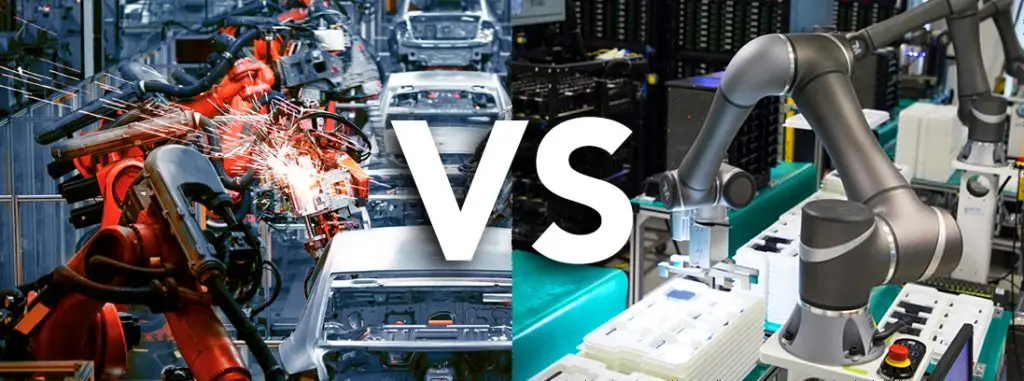
Choosing the right automation for your business often comes down to understanding the fundamental differences and relative merits of Collaborative Robots (Cobots) and Traditional Industrial Robots. They are not interchangeable; rather, they are complementary tools designed for different industrial needs and environments. For robotics cognoscenti, the great debate of our time is: “what is better, a cobot or a robot” for robotic assembly, finishing or machine tending? People line up on both sides of this argument, with equal degrees of passion. Online journal “Asian Robotics” is a website that falls on the side of passionate support for cobots.
Core Difference: Collaboration vs. Isolation
The most crucial distinction lies in their operating environment and safety features:
Traditional Industrial Robots: These are high-speed, high-power machines built for maximum throughput. Their speed and strength necessitate that they operate in isolation, typically behind safety cages or barriers, to protect human workers. They are built to work in place of humans.
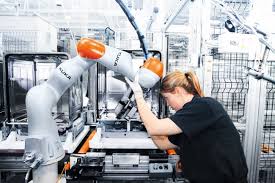
Collaborative Robots (Cobots): Cobots are designed to work alongside humans in a shared workspace. They are equipped with advanced safety features like force/torque sensors, lower speed limits, and rounded edges, allowing them to stop or slow down upon contact or proximity with a person. They are built to work with humans.
Relative Merits: Speed, Strength, and Flexibility
| Feature | Traditional Industrial Robots | Collaborative Robots (Cobots) |
| Primary Goal | Maximize speed, power, and precision. | Maximize flexibility, safety, and human collaboration. |
| Speed & Payload | High speed and high payload capacity. Ideal for heavy-duty, high-volume tasks. | Lower speed and limited payload capacity (to ensure safety). Ideal for lighter tasks. |
| Safety & Space | Requires extensive safety barriers (cages/fencing) and more floor space. | Requires minimal or no external safety barriers (after risk assessment). Compact and space-saving. |
| Programming | Complex programming often requires specialized expertise and coding. | User-friendly interfaces, “teach” modes (manual guidance), and quicker reprogramming. |
| Flexibility | Rigid/Fixed for high-volume, repetitive, long-term tasks. Less adaptable to change. | Highly flexible and easily redeployed to different tasks or stations. Ideal for small-batch/variable production. |
| Cost | Higher initial investment, complexity, and maintenance costs. | Lower initial cost and simpler integration, leading to a faster Return on Investment (ROI) for many SMEs. |
| Typical Applications | Welding, painting, heavy material handling, high-volume assembly (e.g., automotive). | Light assembly, machine tending, pick-and-place, quality inspection, packaging, and sorting. |
When to Choose Which
Choose a Traditional Industrial Robot when:
Your task requires extreme speed and power (e.g., fast cycle times or lifting heavy components).
The work process is fixed, highly repetitive, and high-volume.
You can dedicate a separate, protected workspace for the robot.
You prioritize maximum throughput above all else.
Choose a Collaborative Robot (Cobot) when:
The task requires human-robot interaction or oversight (e.g., assembly where a person performs a tricky step).
You have limited floor space and need a compact, barrier-free solution.
Your tasks change frequently or you produce in small batches (high-mix, low-volume).
You are an SME (Small-to-Medium Enterprise) looking for a cost-effective, easy-to-deploy entry into automation.
The task is dull, repetitive, or ergonomically taxing for human workers, freeing them for higher-value, more complex work.
- One of the biggest players in Cobot world is based in Denmark, with financial backing from their joint U.S. parent company Teradyne, Mobile Industrial Robots (MiR) and Universal Robots (UR) have acquired a 50,000 m2 building site in Odense,Denmark where $36M will be invested in the construction of a major cobot hub in the “cobot capital” of the world. Collaborative robots – or cobots – are now the fastest growing segment of industrial automation.
Both Robots and Cobots are essential to the future of automation. Your final choice should be based on a thorough risk assessment and an analysis of your specific production needs—prioritizing the right tool for the job.