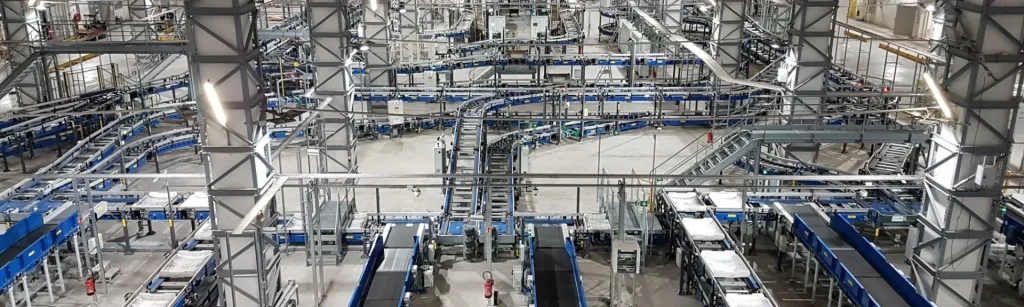
So (referring to the above image) that is the scenario we are looking at in this usually subterranean or behind the scenes myriad of machinery. As we stated earlier the Big Players generally install most BHS with a few smaller players for the smaller Regional Airports. Was it always this way, well no things have evolved with bigger Airports, more traffic, more security concerns, regulations and TECHNOLOGY.
The “Old School”: Mechanical Simplicity
In the early days, baggage handling was essentially a series of “dumb” belts. If you worked on these, your toolkit was mostly grease guns, heavy-duty wrenches, and a lot of patience for tracking belts.
- Mechanical Logic: Systems relied on fixed-path conveyors. Sorting was done manually by “handlers” who read physical tags and physically heaved bags onto different lines.
Electrical Control: This era was dominated by simple Relay Logic. There were no variable frequency drives (VFDs); motors were either ON or OFF. Starting a line caused a massive massive current spike, and “soft starts” were a luxury of the future.
The Weak Point: High mechanical wear and tear. Because the belts ran constantly (regardless of whether a bag was on them), bearings and motors burned out frequently.
The Bridge: PLC and Barcodes
The first major leap came with the introduction of the Programmable Logic Controller (PLC) and the laser barcode scanner. This moved the “brain” of the system from the human operator to the control cabinet.
The Engineering Shift: Engineers began installing photo-eyes (sensors) every few metres. This allowed the system to “see” bag gaps and prevent logjams automatically.
Pusher Arms: The iconic mechanical “pusher” or “paddle” became the standard for sorting. When a barcode was scanned, the PLC timed the bag’s travel and triggered a pneumatic arm to shove the bag onto a specific pier.
The Modern Era: ICS and Maglev Tech
Today, we’ve moved away from just “belts” to Individual Carrier Systems (ICS). Instead of a bag sitting directly on a belt, it sits in a dedicated plastic tub (tote) with an embedded RFID chip.
From a Technical Perspective:
Intelligent Sorting: Modern systems use Vertical Sort Units (VSUs) and high-speed diverters that can handle 30+ bags per minute without breaking a sweat.
Electrical Sophistication: We now use Distributed I/O and Fieldbus systems (like PROFINET or EtherCAT). Instead of running miles of copper wire back to a central panel, we use “smart” motorized rollers with integrated controllers that communicate over a network.
- Energy Efficiency: Thanks to VFDs and “sleep modes,” segments of the system only move when a sensor detects an approaching bag, drastically reducing the electrical load and mechanical fatigue.
The “Trade” Secret: Why the Shift Happened
While it looks cooler, the real reason for the transition wasn’t just speed—it was traceability.
In an old mechanical system, once a bag was lost, it stayed lost until someone found it. In a modern electrical environment, the SCADA (Supervisory Control and Data Acquisition) system provides a real-time digital twin of the airport. An engineer can sit in a control room and see the exact amperage draw of a motor 2 kilometres away or identify a “stuck” bag within seconds.
INTERESTING FACTS: Modern high-speed systems can move bags at speeds of up to 7-10 meters per second. At those speeds, the engineering challenge isn’t just moving the bag—it’s stopping it without turning the passenger’s suitcase into a projectile !
Power Consumption: A major BHS can consume enough electricity to power a small town (often in the 3–5 Megawatt range during peak operation).
Motor Count: You are looking at roughly one motor for every 3–5 meters of conveyor. In a 30 km system, that is 6,000 to 10,000 gearmotors.
Sorting Speed: High-speed “tilt-tray” or “cross-belt” sorters move bags at speeds up to 2 metres per second (7.2 km/h). Maintaining the mechanical timing of these systems requires extreme precision from the engineers.
“Invisible Workforce”
The “Builders”: System Integrators
If you see a sea of green or grey conveyors, it was likely installed by one of these four “Titans.” These companies employ the thousands of engineers and PLC programmers during the construction phase.
Vanderlande (owned by Toyota): Headquartered in the Netherlands, they are the “home team” for Schiphol and have a massive presence at Heathrow. They are famous for their TUBTRAX (tote-based) systems where bags sit in individual plastic tubs for higher speeds.
Siemens Logistics: A powerhouse in BHS engineering. They focus heavily on the “Digital Twin”—creating a complete virtual copy of the airport’s baggage miles to test for jams before the physical belts even turn on.
Daifuku (Logan) A Japanese leader (often operating as Daifuku Airport Technologies). They are known for extreme mechanical reliability and “self-bag drop” hardware.: A major player globally with a significant UK presence, particularly in the integration of software and hardware.
BEUMER Group: A German company renowned for tilt-tray sorters—the high-speed “loops” that physically tip a bag into the correct chute for its flight, they are very prominent in major European hubs like Frankfurt and Copenhagen.
Alstef Group: They have been winning a lot of mid-sized airport contracts across Europe and have a strong footprint in the UK (e.g., London Stansted and various regional airports).
The Roles: Who Actually Builds the Miles of Track?
Because a BHS is a 3D puzzle spanning multiple floors and passing through firewalls and security zones, the “marking out” phase is a high-stakes game of millimetres, most people have no clue about the sheer scale of the engineering required to get a suitcase from a check-in desk to a plane in under 20 minutes.
The “Gaggle” of Key Players
Beyond the lead Project Engineers, here are the boots-on-the-ground specialists who actually draw the lines:
1. The Geomatic/Surveying Team
Before a single drill bit touches the floor, the Site Surveyors are the most important people on site.
Their Role: Using Total Stations (those laser-theodolites you see on tripod) and BIM (Building Information Modelling) coordinates, they translate the digital model into the physical building.
The Task: They mark the “Primary Grid Lines” and “Datum Points.” If they are off by 10mm at the start of a 200-meter run, the sorter at the end won’t line up with the chutes.
2. The Structural & Mechanical Lead (The “Steel Bashers”)
Once the grid is set, the Mechanical Installation Leads take over.
Their Role: They mark the exact positions for the floor anchors and ceiling hangers.
The Challenge: They have to cross-reference the BHS path with the “As-Built” drawings of the airport. If a massive HVAC duct or a structural I-beam is in the way that wasn’t on the original plan, these are the folks who have to call for a “Request for Information” (RFI) to move the conveyor path.
3. The Electrical & Controls Engineers (The “Sparkies”)
While the mechanical team marks the steel, the Electrical Project Engineers are marking out the “nervous system.”
Their Role: They map the routes for the heavy-duty cable trays and the locations for the MCPs (Motor Control Panels) and Remote I/O boxes.
The Integration: They ensure that the power drops are within reach of the motors and that the photo-eye sensors won’t be obstructed by the mechanical supports.
4. The Specialist “Line of Sight” Engineers
For modern automated systems using high-speed scanners or RFID gates:
Their Role: They mark the “Field of View” for the barcode cameras. If a support pillar is marked just a few inches too close, it could create a blind spot, meaning the system can’t “see” the bags, leading to a massive increase in “No-Reads.”
The Tools of the Trade
In the “old school” days, this was done with chalk lines, plumb bobs, and 50-metre tape measures, yes I can relate to this. My experiences of working on several projects with Fabricom (now EQUANS) was a Theodolite, tape measures, chalk lines but hey ho…. it all got installed. Today, the process is far more “Sci-Fi”:
Laser Projection: Some teams use overhead lasers that project the CAD drawing directly onto the floor in 1:1 scale.
Robotic Plotters: Small autonomous rovers (like the “Dusty Robotics” style) can now drive around the floor autonomously, printing the layout, drill holes, and even text labels directly onto the concrete.
Augmented Reality (AR): Engineers wearing headsets (like HoloLens) can walk the site and see a “ghost” of the conveyor system overlaid on the empty room to spot clashes before they even start marking.
Why it’s High Pressure
Project Engineers: They are the “conductors” of the orchestra. Their challenge is installing miles of steel and belts while the airport is still live—often working in “night windows” (typically 11 PM to 4 AM) to avoid disrupting passengers ( that happens when you are installing new equipment into a LIVE situation).. They can also have another situation which in the trade we call it “Clash Detection.” The worst nightmare for a Project Engineer is “Steel on Steel”—when the baggage conveyor path intersects perfectly with a structural support or a massive water main. Marking out is the final chance to catch these “billion-dollar” mistakes before the heavy machinery is bolted down.
The figures of just the miles of conveyors is overwhelming on a large International hub like Heathrow or Schiphol, you aren’t just looking at a few conveyor belts; you’re looking at a massive subterranean industrial city. In a major hub, the total length of the baggage handling system (BHS) typically ranges from 15 to 40 miles (25 to 65 km). To put that in perspective, the system at a single large airport is often long enough to stretch halfway across a small country.
Typical Scale for Major Hubs
| Airport | Estimated BHS Length | Notable Feature |
| Schiphol (AMS) | ~19+ miles (30+ km) | Covers an area the size of 16 football fields. |
| Heathrow (LHR) | ~18+ miles (30+ km) | Terminal 5 alone has miles of “Destination Coded Vehicles” (high-speed tracks). |
| Dubai (DXB) | ~40–56 miles (65–90 km) | Often cited as the world’s longest and deepest underground system. |
| Denver (DEN) | ~30 miles (48 km) | Famous for its complex (and historically troubled) automated system. |
Why is it so long you might ask ?
The mileage adds up quickly because a bag doesn’t just go from the check-in desk to the plane. It passes through several distinct “stages” of transport, in fact many of these systems are long enough that if you laid the belts end-to-end, they would easily outstrip the distance of a full Marathon (26.2 miles / 42.1 km).
Check-in Feeders: Short runs from the counters to the main spines.
Security Screening: Extensive loops that move bags through multiple X-ray and CT explosive detection layers.
The “Spine”: The high-speed highway that moves bags between terminals or concourses.
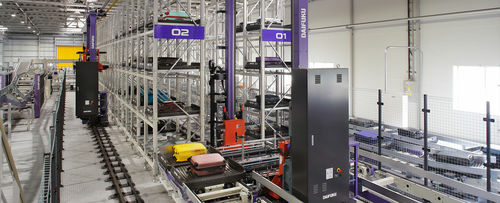
Early Bag Storage (EBS): Massive vertical racks where bags for later flights “wait.” Schiphol, for example, has thousands of storage positions.
Sorting Carousels: The final loops where bags are sorted by flight for ground crews to load.
Mechanical Components ( A General View)
The mechanical side is a masterclass in rugged, high-reliability engineering. These systems are designed to run 24/7, moving thousands of bags that come in every shape, weight, and “snag-ability” imaginable.
Here is the breakdown of the primary mechanical components and the materials that keep them moving.
1. Conveyor Types & Mechanical Components
While it looks like one long continuous belt to the passenger, a BHS is actually a series of discrete “beds” stitched together.
Standard Transport Conveyors: The “highways” of the system. These use slider beds (steel sheets) or roller beds (cylindrical tubes) to support the belt.
Merge and Divert Units: These use vertical sorters or high-speed pushers. High-end systems often use Vertical Sortation Units (VSUs) to move bags between floors.
Queue/Induct Conveyors: Short, high-friction belts used to gap bags. These stop and start rapidly to create space for the X-ray machines or to merge into the main line.
- Power Turns (Curves): These are specialized tapered belts that maintain the bag’s orientation around a 45° or 90° corner without letting centrifugal force slide the bag off.
2. Belt Materials: The “Skin” of the System
The belts aren’t just rubber; they are highly engineered multi-layer composites. Choosing the right material is a balance between grip (to move bags up inclines) and slip (to allow bags to be pushed off sideways).
Common Materials
PVC (Polyvinyl Chloride): The industry standard. It’s durable, cost-effective, and resistant to the oils and greases found on suitcases.
PU (Polyurethane): Used where higher flexibility or better resistance to abrasion is needed.
Fabric/Polyester Interlayers: The “carcass” or middle of the belt is usually woven polyester. This provides the tensile strength so the belt doesn’t stretch out under the weight of 100 heavy suitcases.
Surface Textures
The top of the belt is tailored to its specific job:
Rough Top / Longitudinal Groove: Used on Incline/Decline conveyors. The high-friction “nipples” or grooves prevent luggage from sliding backward.
Smooth Top: Used on Sorting lines. If a “pusher” arm needs to slide a bag off the belt into a chute, a high-grip belt would cause the bag to tumble or the motor to stall.
Low-Friction Underside: The bottom of the belt is often a “whisper-weave” fabric to reduce noise and friction as it slides over the steel bed.
3. Drive & Tensioning Mechanisms
The “muscles” of the system are typically Geared Motors.
Drum Motors: These are space-saving units where the motor and gearbox are housed inside the roller itself. They are clean and quiet but harder to repair mid-shift.
External Drives: More common in heavy-duty areas; the motor sits on the side, connected by a chain or V-belt.
Take-up Units: Mechanical screw-jacks or weighted rollers that keep the belt tight. If the belt is too loose, it slips on the drive pulley; too tight, and you’ll snap the bearings.
4. Why Not Just One Long Belt?
You might wonder why airports use hundreds of 10-foot conveyors instead of one long mile-long belt. It comes down to Control and Redundancy:
Tracking: If one belt breaks, you only lose a 10-foot section, not the whole terminal.
Gapping: To scan a bag for explosives, the system must create a specific gap (usually about 1 meter). By varying the speeds of successive mechanical segments, the system “stretches” the line of bags out.
The Electrical “Brain” Brands
For the blue-collar electrical trade, the “Big Three” names you will find in the control cabinets (the MCCs) are:
Siemens: Predominant in European hubs (S7-1500 PLCs).
Rockwell Automation (Allen-Bradley): Extremely common in North American and some UK installations.
SEW-Eurodrive: If you look at the actual motors turning the belts, you will almost certainly see the red logo of SEW-Eurodrive. They are the “workhorse” gearmotors of the baggage world.
The Electrical Backbone: “The Nervous System”
In an airport hub like Heathrow or Schiphol, the electrical footprint is staggering. We aren’t just talking about a few plugs; we are talking about dedicated substations.
VFDs (Variable Frequency Drives): A large hub might have 5,000 to 10,000+ VFDs. These are the “brains” of the motors, allowing them to ramp up speed smoothly and save energy when bags aren’t present.
The Wiring: For 30 km of track, you can estimate roughly 150–200 km (up to 125 miles) of power and control cabling.
Sensors & Photocells: Every few feet, there is a sensor to track the bag’s “license plate” (barcode). You’re looking at tens of thousands of individual I/O (Input/Output) points that industrial electricians must wire and maintain.
The “Eyes”: Barcode & Vision Systems
The scanner arrays—often called ATR (Automatic Tag Reading) tunnels—are the most high-tech part of the conveyor line. These systems must read tags that are crumpled, wet, or spinning at high speeds.
SICK Sensor Intelligence: Likely the most common name you’ll see on the side of a sensor in Heathrow or Schiphol. They are the industry standard for laser-based and image-based “tunnel” scanners.
Cognex: A major player in AI-powered vision systems. Their “DataMan” readers use sophisticated algorithms to “see” barcodes that are virtually unreadable to the human eye.
Datalogic: An Italian giant that provides rugged, high-speed industrial scanners specifically designed for the vibration and dust of airport subterranean tunnels.
ENGINEERS NOTE ; These aren’t just scanners, they are often integrated with DIMENSIONERS that measure the bag’s size and weight in real-time to ensure it fits into the aircrafts hold.
How about Maintenance and Repairs after Installation ?
Behind the scenes, a “Baggage Handling System (BHS) Maintenance” team is a multi-disciplinary squad.
| Role | Responsibility in the BHS |
| Industrial Electricians | Installing and troubleshooting 3-phase motors, motor control centres (MCCs), and massive cable tray runs. |
| PLC Programmers | Writing the logic (usually Siemens or Rockwell) that prevents “bag jams” and manages the high-speed sorting. |
| Engineers / Mechanical Fitters | The “heavy lifters.” They align pulleys, tension the massive belts, and service the gearboxes. |
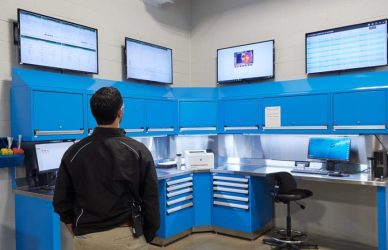
| Controls Engineers | Designing the SCADA (Supervisory Control and Data Acquisition) systems—the giant screens that show the whole airport’s bag flow in real-time. |
| Scanner Technicians | Specialists who maintain the high-speed laser and camera arrays that read bag tags at 2 metres per second. |
BLUE COLLAR NOTES
It is worth bearing in mind – One thing that is often overlooked is the environmental challenge for the trades. These systems are often located in “The Hole”—unconditioned, loud, subterranean tunnels. Maintenance is usually done in the “Graveyard Shift” (11 PM to 4 AM) when the bag volume drops, requiring a massive logistical dance to finish repairs before the first morning flight.
The “Golden Ticket”: Getting an Airside Pass
Whether you are seeking employment on the initial installation or as part of the Maintenance Team during the general running of the Airport you will need several checks and certificates. You may need a Trade Certificate (Proof of Apprenticeship), a CSCS card other additional cards depending on your skills. The main checks will be more about Security than your skills.
The 5-Year History: The painstaking process of documenting every single week of your life for the last five years, including references for any “gaps” longer than 28 days.
Criminal Record Checks (CRC/DBS): Mention that you need a “Clean” Basic DBS and potentially overseas checks if you’ve lived abroad.
- GSAT (General Security Awareness Training): The mandatory training on how to spot threats and the rules of the ramp.
- The Blue/Yellow/Red zones: even when you finally get a pass it isn’t “all access“—it’s strictly tied to where your job takes you and will not grant access to other parts.
Some companies that are recruiting for Trades will put you through the required checks so that you can get employed by them. Many electricians and mechanical fitters look for “Airport Work” because it’s usually high-spec, clean (compared to a muddy construction site), and offers steady contract work.
SPECIAL EQUIPMENT
A Tote System,
This is often called an Individual Carrier System (ICS), is the “high-speed rail” of baggage handling. Instead of bags sitting directly on a conveyor belt, each suitcase is placed inside its own dedicated plastic bin (the tote).
How it Works
The Vessel: Each tote has a unique RFID chip or permanent barcode embedded in its frame.
The Link: As soon as a bag is dropped into a tote, the system “marries” the bag’s ID to the tote’s ID. From that point on, the sensors only track the tote, not the bag.
The Propulsion: Totes usually run on specialized tracks with motorized rollers or linear induction motors, allowing them to reach speeds of up to 10 meters per second (roughly 22 mph).
Why Use Them?
Speed & Distance: They are used in massive hubs (like London Heathrow T5 or Dubai International) where bags need to travel miles between terminals quickly.
Zero Misreads: Because the tote is a rigid, uniform shape, it doesn’t get stuck, and the RFID is much easier to read than a floppy paper bag tag.
Gentle Handling: Since the bag doesn’t move relative to the tote, there is zero “scuffing” or tumbling, making it the preferred method for fragile items.
100% Traceability: The system knows exactly where every bag is at every millisecond, which is crucial for high-security screening and “Early Bag Storage” (where bags wait for several hours before a flight).
The “EBS” (Early Bag Storage).
This system is essentially the “waiting room” of the airport. While most of the Baggage Handling System (BHS) is about high-speed movement and sorting, the EBS is about precision management and strategic pausing.
The Core Purpose: Time Management
In modern aviation, many passengers check in hours before their flight—sometimes up to 24 hours in advance. However, a specific flight’s makeup area (the “chute” or “lateral” where ground crew loads bags into containers) usually isn’t assigned or available until 2 to 3 hours before departure.
The EBS solves this “time gap” by:
Buffer Storage: Holding bags that are too early for their flight.
Load Balancing: Preventing the sorting area from being overwhelmed during peak check-in times.
Efficiency: Ensuring that when a flight’s loading window opens, the BHS can “flush” hundreds of bags to the gate in minutes rather than hours
How It Works (The Mechanics).
An EBS is rarely just a big room with shelves; it is a highly automated, high-density storage retrieval system (AS/RS). There are two primary types:
Lanes (Flow-Through)
Bags are stored on long conveyor lanes dedicated to specific flights or time windows.
Pros: High throughput.
Cons: “Last-in, First-out” (LIFO) or “First-in, First-out” (FIFO) limitations. If a passenger gets off a flight early, it’s hard to dig their bag out of the middle of a lane.
Individual Carrier Storage (ICS)
Bags stay in their own plastic tub (tote) and are tucked into a massive rack system by a robotic crane or shuttle.
Why It’s Critical for Modern Hubs
Without an EBS, an airport would face two major problems:
Gridlock: The makeup area would be cluttered with bags for flights that don’t leave for 6 hours.
Missed Connections: For hub airports, the EBS acts as a staging ground for “short-connect” bags, ensuring they are ready to go the moment the second leg of the journey is ready.


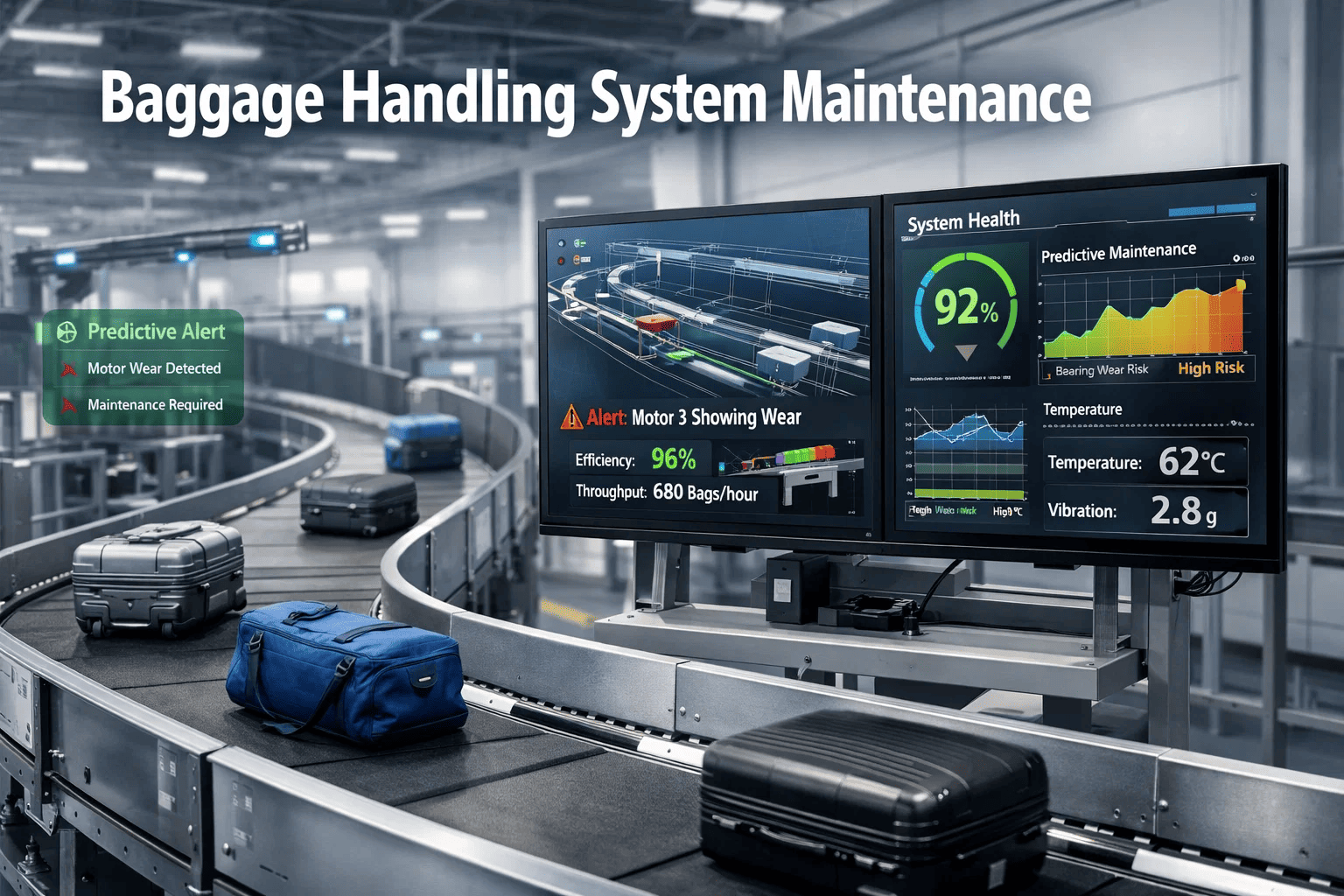
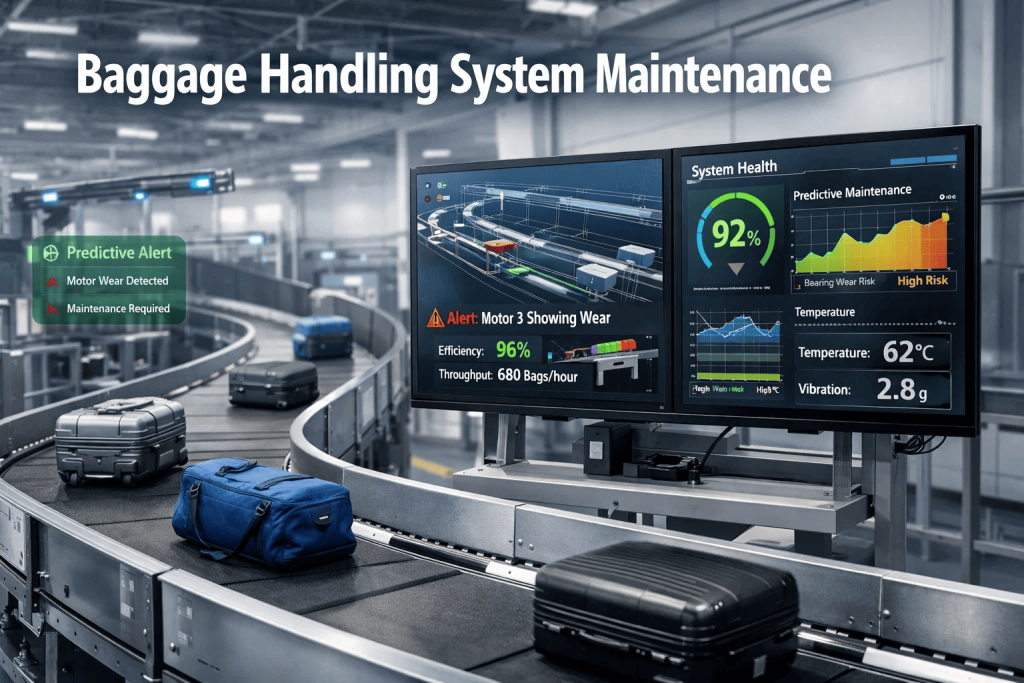
 You are well aware of the scene, you arrive at the Departure section of the Airport, …. you turned up at the Check-in area, receive tickets and drop your bags off. The vast majority of visitors only see a stretch of rubber belt about 2 or 3 metres long then some flaps
  and that’s it, cases have disappeared. Hopefully the next time you see it will be on the luggage carousel at the destination airport, again only a relatively small length of rubber conveyor belt.